No.3 Hobbes’ Lane
FOR SALE: house with spectacular views. No windows.
The Tricky Genre Press is delighted to announce the publication of jjhudsson’s latest EPUB novella, No 3. Hobbes’ Lane—the second in his series of uncanny tales, ‘Foretellings’.
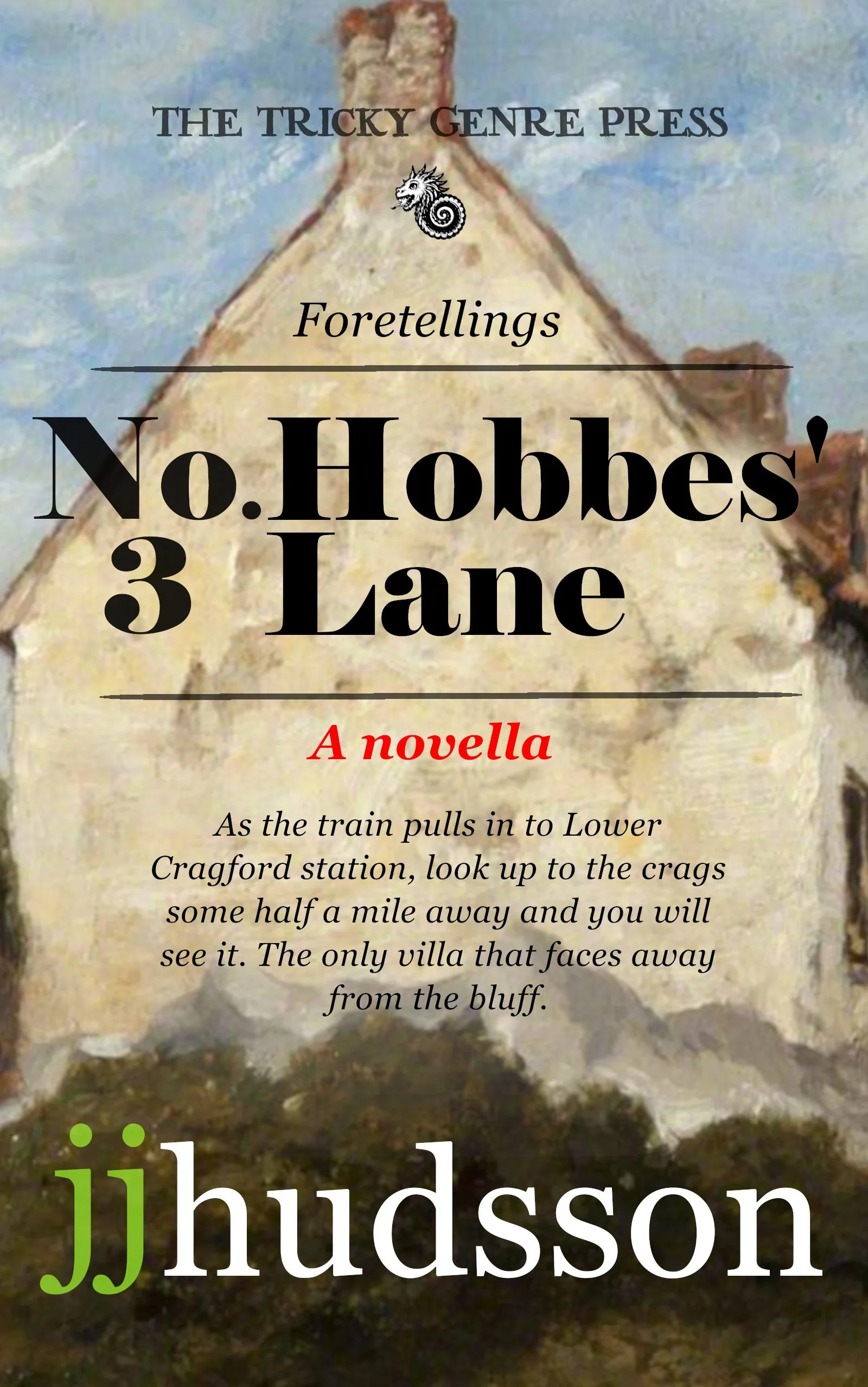
Cover of No.3 Hobbes’ Lane by jjhudsson (The Tricky Genre Press 2026).
No 3 Hobbes’ Lane tells the strange story of Turnabout House, one of five Victorian villas built on a picturesque Edge, overlooking the Streale Gorge in Limewickshire. From the upper windows of these villas one can see all the way across the gorge to the Lowther Fells. But not from No. 3 Hobbes Lane. For the westward facing elevation of this villa has no windows opening onto the magnificent view. In fact, these windows have been removed.
So begins this atmospheric and unsettling tale. Set in the mid nineteenth century, it features ancient wood-folk lore, an oak tree, the Industrial Revolution and the mysterious death of one Ezekiel Hobbes. More than this, we dare not say.
In terms of jjhudsson’s writing, No. 3 Hobbes’ Lane draws on, as far as we know, no pre-existing template (unlike Sika Tarn, the opening of which consciously mimics Algernon Blackwood’s wonderful The Willows. Of course this is a purely subjective assertion; but we are aware of no writer it tries to emulate, no family history it tries to render, no experience it hopes to capture. “It’s a mystery to me where it came from,” the Storyteller confessed to us. “The Swiss-German painter Paul Klee is credited with saying that a line is a dot that went for a walk,” he added in an uncharacteristic bout of effulgence. “I tend to think of writing in a similar vein: a story is a thought that went for a walk”. Evidently jjhudsson has no shortage of weird thoughts, and we know he likes walking.
The only other nugget we have managed to prise from the writer’s dead hands concerning this story is that the starting point for No.3 Hobbes’ Lane is an observation jjhudsson had occasion to make on countless train journeys across England as he travelled to and from university. “I noticed that there was one point along the line that I rarely, if ever, failed to look up at—precisely as it hove into view.” It seems that no matter how deeply engrossed he was in working or reading, he always broke off and looked up at the exact moment his speeding train passed this particular vista. It was—not to put too fine a point on it—uncanny. The storyteller quickly formed a theory to explain the phenomenon which we won’t bother the reader with just now, but it is this same sensation that starts Bennellick (the hero of our tale) on his ruminations about the Turnabout House.
Landscape continues to be a major theme running through the writing of jjhudsson, and it will come as no surprise to our readers that No 3. Hobbes’ Lane features his trademark worldbuilding. The story is set in the idyllic Streale Gorge, a deep river valley that marks the border between the English counties of East Treponshire and Limewickshire. Here the river is bounded by precipitous limestone ‘edges’ on either side. It is upon the eastern edge, in the little hamlet of Upper Cragford, that a good part of the action takes place.
Autograph sketch of the so-called ‘Six Bridges line’, as described in No.3 Hobbes’ Lane.
Map of the Six Bridges Line (c. 1888).
Of course, none of these towns, villages and topographical actually exist. They are the very real imaginings of jjhudsson. In the case of No. 3 Hobbes’ Lane the Storyteller furnished us with a pencil sketch of a map showing the lower part of the Steale valley with the main locations marked on it (left hand image). It was Jess, our Illustrator, who managed to turn this scrap of greasy paper into a lovely map, a version of which we have included in the front matter of the EPUB.
The cover for No. 3 Hobbes Lane is another example of Jess’s handiwork. Believe it or not paintings depicting houses with no windows are few and far between. Jess used this image of a painting by David Cox the Elder, entitled ‘A Cottage on a Hillside’ which seemed to capture the vibe of Turnabout House. The artist painted this house from a position below it, thus setting the dwelling against the skyline and giving it (for our purposes) a sense of vertiginous isolation. Jess used the ever-wonderful GIMP to hone on on the gable end of Cox’s house, to give us the feeling of a facade, and then removed the two existing windows (using the cloning tool, in case anyone is interested) to put us in mind of the ‘blinded’ Turnabout House.

‘A Cottage on a Hillside’ by David Cox the Elder (c. 1800-1859).
We cannot conclude this brief introduction to No.3 Hobbes’ Lane without a snatch of gossip gleaned from the dusty and mostly empty rooms of The Tricky Genre Press. Someone (we can’t say who) overheard The Storyteller telling Nigel that the tale was a favourite of the dedicatee. Well, “D.W” (wherever you are) we hope you approve of our new edition.
You can read No.3 Hobbes Lane on your Kindle, Kobo or any e-reader. To download the EPUB go to The Tricky Genre Press website and look for it under ‘Novellas & Short Stories’. For a short period of time the download is free. ‘Foretellings’—the complete collection of all four novellas—will be available around Christmas 2026.
NOTES
The cover image features the painting ‘A Cottage on a Hillside’ by David Cox the Elder (c. 1800-1859), Public domain, via Wikimedia Commons; it is in the collection of the National Trust, Wallington Hall, UK. The digital image used here has been modified to work in the present cover format; in particular two windows have been removed from the side elevation. Licenses can be viewed at https://commons.wikimedia.org.
The maps, EPUB cover and blog text are © The Tricky Genre Press 2026.