
Poetic lies n’ sense
jjhudsson writes poetry too…
Eagle-eyed visitors to The Tricky Genre Press home page will have noticed, among the genres so ill-favoured as to be termed ‘tricky’, one titled ‘Poetry’. The especially curious may even have ventured to tickle the drop-down menu under that heading, thus revealing, to general embarrassment, three e-booklets of poems by jjhudsson.
What are we to make of this? Has jjhudsson gone soft in the head? Is he ill? Could it be that he is in love? How are we to explain that an apparently ordinary (if somewhat uncouth) man should suddenly go all Wordsworth on us? We thought it high time to give our readers an explanation.
The truth is that none of the poems in these short collections were written for publication. They exist, with one or two exceptions, in the marginalia of the autograph manuscripts of jjhudsson: that is; the various stories concerning Professor Summanus Horthólary - the eighteenth century Gallic sleuth whose escapades with giants, witches and early flight can be read in The Lays of Maladie series; the intergalactic and philosophical wanderings of Menlo, in the novel Other Places Which Also Are the World’s End; and in an emerging work that seems to revolve around an improbable combination of vikings and modern defence espionage.
The subject of jjhudsson’s marginalia is examined in more detail in the Tricky Genre Blog Nea-ly, but not Quite. Here, we need only observe that there is scarcely a page of autograph MS that does not have on its margins or, more frequently, verso, a handwritten note-to-self, plot idea, spell, character name or, as in the case here, a few lines of verse.
In fact, when you know what to look for, there is quite a lot of verse. Thus far, we have discovered at least fifty complete poems among the archive, and hundreds of orphaned lines which must surely relate to some poetic thought or other in the mind of jjhudsson.
Publish and be Damned
But if these jottings were not written for publication, why publish them now? Indeed, why publish them at all?
Two reasons. First, as a corpus, they provide a rare glimpse into the mind of jjhudsson. As anyone who has read his obscure and self-written biography on the Tricky Genre Press website will appreciate this is not a man who cares to share his persona with the world. In these poems, perhaps, we can gain insight into the mind that creates planets, dragons, religious cults and a whole administrative Department of France.
Secondly, jjhudsson has allowed us to do so. Well, perhaps ‘allow’ is overstating things: he has not forbidden their publication. When we showed him the galleys for the first e-booklet, Splash!, they came back with a few notes which we have included at the end of the booklet (and each subsequent volume), and some minor edits. We take this to be sanction enough.
Lest you think we’re making all this up (perish the thought) or, worse, lying, here’s an example. It’s about a boy and he’s slipped away from his parents to discover a puddle. Oh, and be careful - there’s a bus…
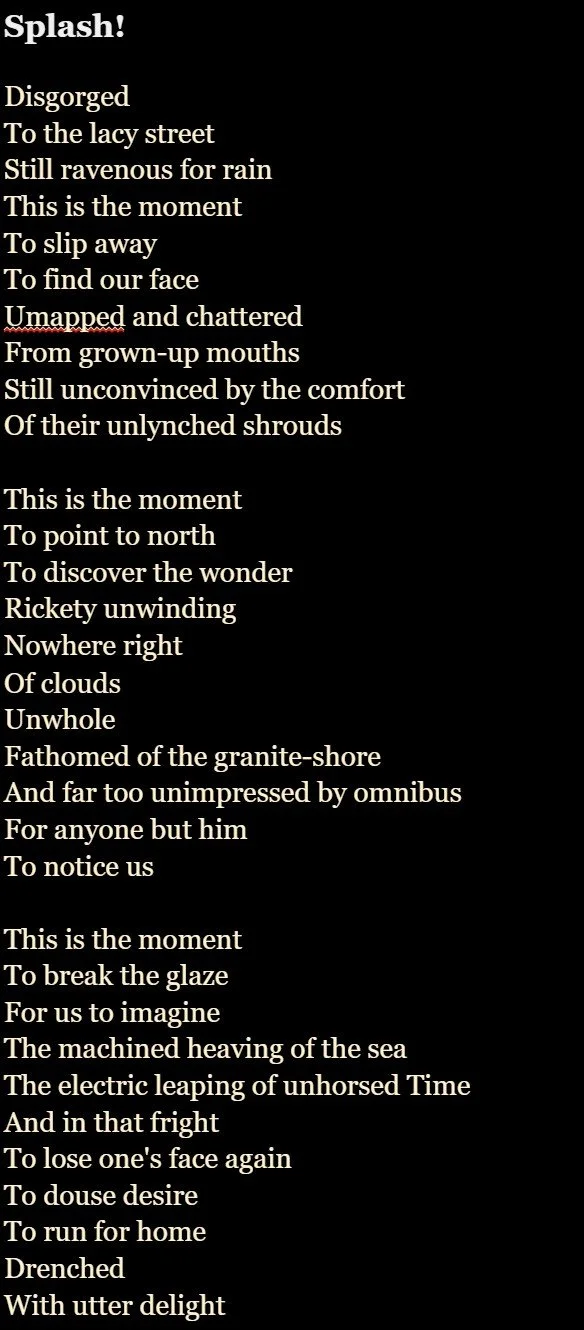
From Volume One (Splash!) of ‘Ringshout, the Collected Poems of jjhudsson’ (The Tricky Genre Press 2026).
The situation is Graves
“A poem”, wrote Horthólary at the end of the eighteenth century, “is a feeling lost in time and space; there is nothing concrete about it.”
If that is true, no poem can be said to have universal meaning. Our feelings, our time and our space are unique to us, and the words scratched out on a winter’s evening by a woman when the harvest has been bad and the children are hungry cannot mean the same to the man reading them on the 7.48 to London two hundred years later - even is he is moved to tears. There is an eternal mystery about a poem so charged.
In his book The White Goddess, Robert Graves goes further. To him the poet was a shaman, a mystic, a magician; someone in whom the accumulated spiritual knowledge of the tribe had been vested. And the poems were that knowledge - rhymed, riddled, symbolised and metaphored into something recognisable only to the initiated. To recite a poem like The Battles of the Trees, was, to Graves, to be uttering aloud the inner feelings, emotions, beliefs and histories of our ancient ancestors, if only we knew how to decode them.
Graves’ book was given a wide berth by contemporary scholars. Even the great poetic mystic, T.S. Eliot professed himself dumbfounded by it. But there is something powerful in the idea of the poet as mystic; in daring to suppose that the jumbled words on the page before you are not merely artistic or contorted grammar, but that there is a hidden meaning in them.
We make no such claim for the poems of jjhudsson. These are not the works of a palaeolithic shaman, no matter how primitive his personal habits. They are, however, feelings outside their time and space, as Horthólary expressed it. Therefore, they are - or ought to be - mystical to us, who are not him, and who did not experience that feeling; who were not present in that time, who did not occupy that space. To us, they might seem magical in the mind, if not beautiful in the mouth.
We think that this is probably as close to an explanation of The Storyteller’s poetic turn as any. But you can be the judge of that.
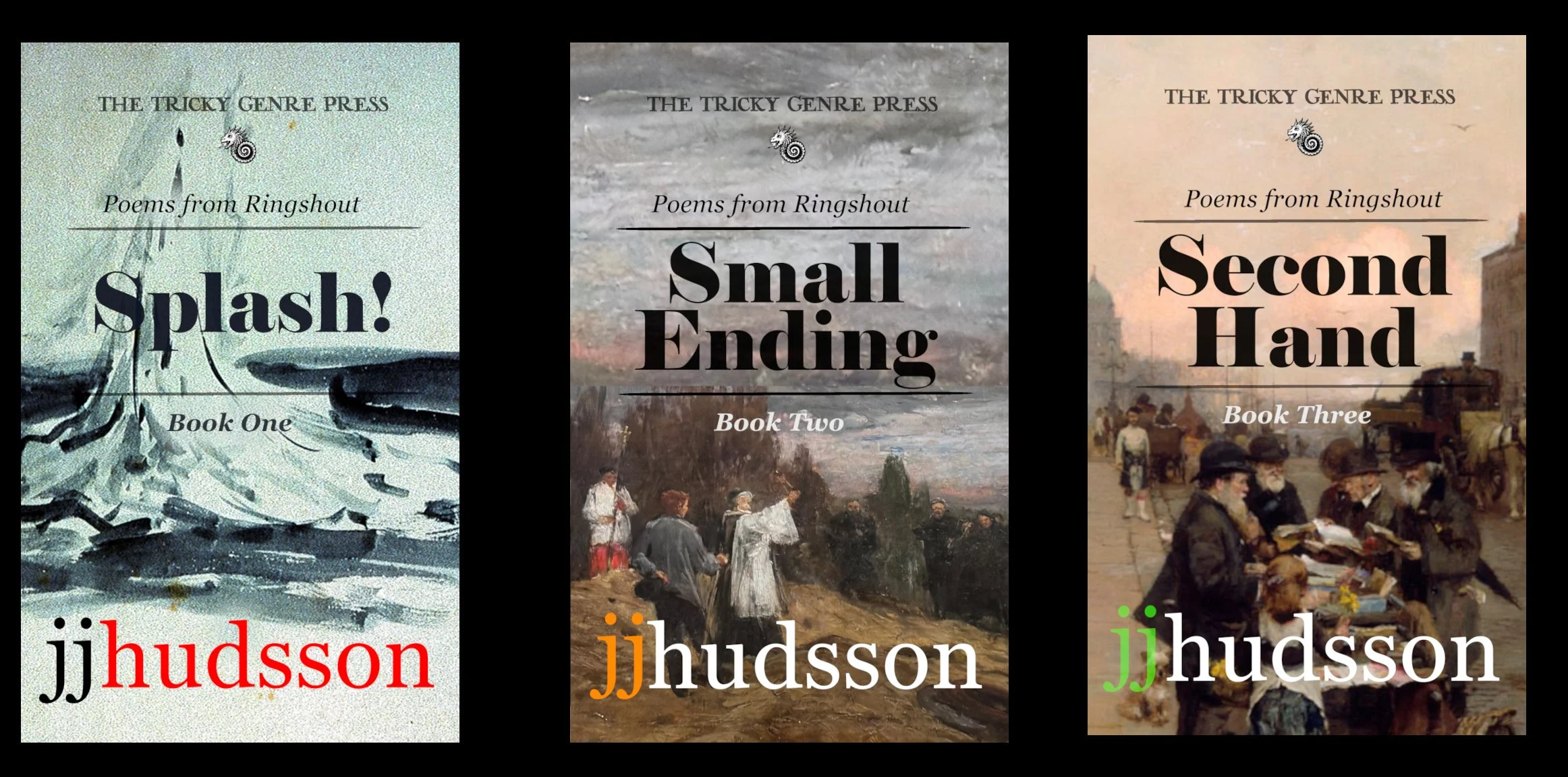
The poems in these short e-booklets (each contains just six of seven poems) cover an array of experiences and the writer’s reaction to them: from the challenges of growing up and finding one’s place in the world (or learning how to manage when we can’t), to the disconnection and banality of loss; from the knowledge of how we came to be, to the passions that created us. And the simple wonder of something extraordinary.
We have included jjhudsson’s notes on each poem at the end of each e-booklet. There—if the reader is so minded—they can find certain textual explanations, notes on structure and occasionally hints at intended meaning. Don’t feel obliged to explore them. A poem lives on the lips and in the mind of the reader. Your understanding is the only meaning that matters.
There may be magical meanings in them, but if there are, they are known only to jjhudsson.
NOTES
Robert Graves, The White Goddess: A historical grammar of poetic myth. Faber & Faber (1948).
T.S. Eliot. See Judith Kroll, Mythology; The poetry of Sylvia Plath. Harper Colphon Edition (1978 cf. pp. 50).
The cover image is the painting ‘Lord Byron on his death-bed’ by Joseph Denis Odevaere (c. 1826). It is held in the collections of Groeningemuseum. Public domain, via Wikimedia Commons.

