No. 3 Hobbes’ Lane
1938. Two companions on a hiking trip to the highlands of scotland arrive at a remote hamlet where they encounter strange sounds and creatures in the mists of an isolated loch …
Read a sample
-
THE TALE YOU are about to read is one of four uncanny stories that come together in the EPUB collection Foretellings. All four stories were originally published in print in 2011 by Tartarus Press, under a different title. They received modest acclaim at that time, being likened to the work of H. P. Lovecraft by some and Arthur Machen by others. The irony is that the writer had read neither of these august authors at that time and was, in fact, earnestly attempting to ape the style of Algernon Blackwood, who remains—in the eyes of jjhudsson—the supreme architect of the uncanny. For the next dozen years the tales lay gathering static (or whatever is the digital equivalent of dust) in various hard-drives and data storage solutions. It is something of a miracle that they were not overwritten or otherwise lost.
The conception of the tales and, we suspect, something of their final presentation owes much to the means of their first digital birthing. They were written on a Blackberry mobile phone, between the hours of 7.42 and 8.10 A.M. and 6.15 and 6.52 P.M., Monday to Friday. Readers old enough to have survived a working life before Covid will immediately recognise the situation. That irritating person tapping frenetically away on their phone, and no doubt muttering darkly aloud to himself, during both the morning and evening train commute was jjhudsson.
Where the stories came from even he is not certain. We do know that none of the tales was planned: “As far as I can recollect,” the Storyteller has told us, “I just started typing into the Blackberry one morning, and never seemed able to stop.”
We can, however, trace certain experiences, idle conjectures and family mythology that have made it through the mental literary crusher and onto these pages.
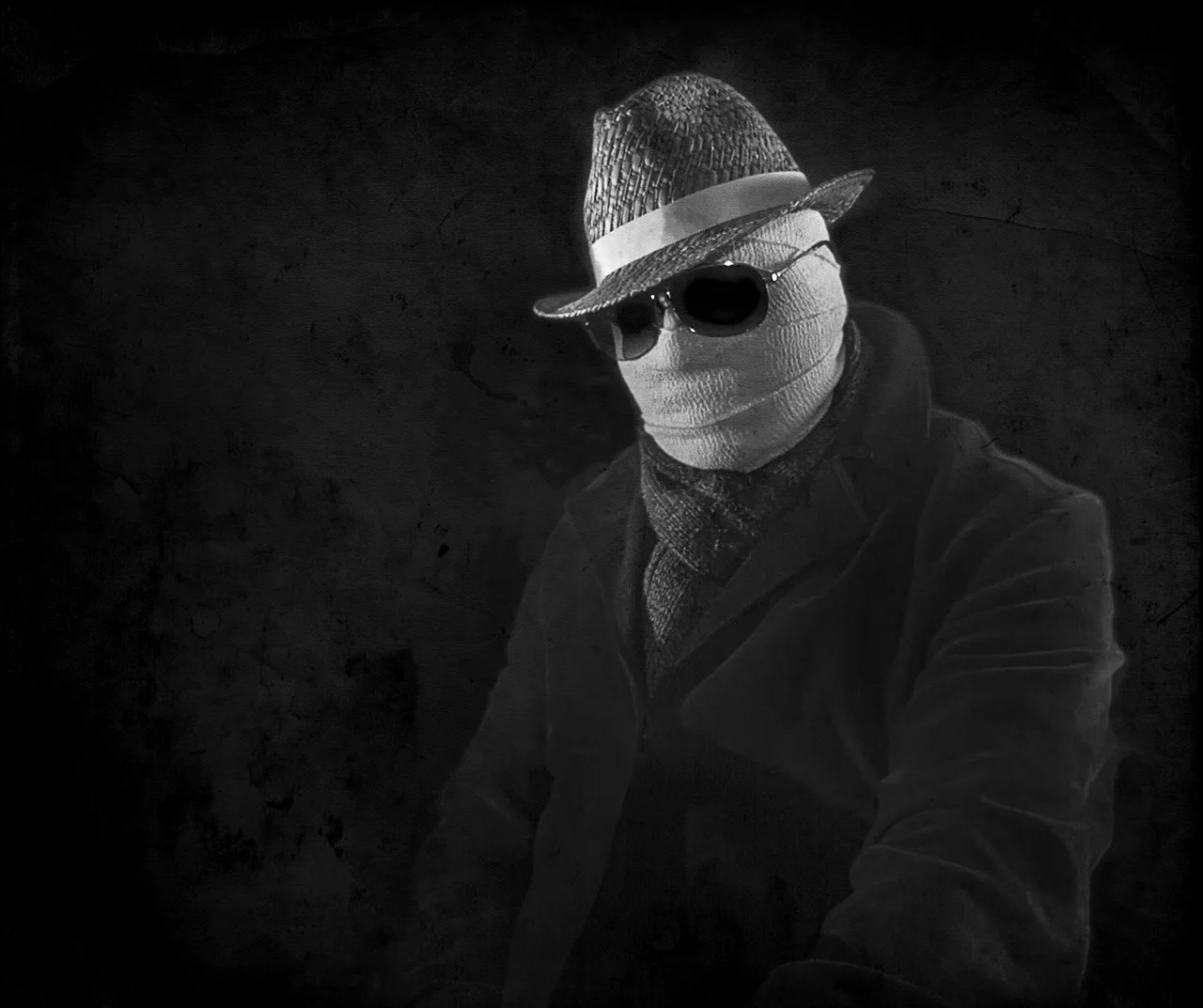
For as long as jjhudsson can remember—which is a birthday party at primary school—he had thought it fanciful that the game he knew then as Chinese Whispers (but which we ought now to call by its alternative ‘Telephone’) might be used for nefarious purposes by Grown-Ups. But the opening of The Rumour Mill—in which the idea is played out—came, he tells us, squarely from H.G. Wells’ masterful The Invisible Man. The Storyteller first read this classic while pretending to suffer from ‘flu at boarding school and thereby granting himself a few days’ well-earned peace and quiet in the school’s infirmary. Apart from The Beano the only other readable book in the place was a collection of H. G. Wells’s stories. jjhudsson devoured them all, prompting much concern from the school doctor who could not reconcile the boy’s studious calm with the jagged edges of his fever-chart (engineered, we learn, using toothpaste and hot tea).
Another identifiable piece of literary DNA can be found in Sika Tarn. It is the tale of two companions who set out on a walking trip shortly before the Second World War. Their journey takes them to the far west coast of Scotland, where they arrive at an isolated community perched between the restless North Atlantic Ocean and the brooding height of the local peak, the fictional Ben Callister. Straight away the friends encounter strangenesses, none of which—in and of themselves—is very remarkable, but which gradually accumulate into something more unnerving. Here, the premise of the tale is a shameless mimic of The Willows, by Algernon Blackwood - for our money one of the finest examples of uncanny fiction you can read. Sika Tarn deviates from Blackwood’s eerie tale in circumstances if not in theme. However the events—and the places wherein they take place—are mostly recollected from various family holidays taken in the north of Scotland. Indeed, it might be said that the ending of the tale is the only part of Sika Tarn that is truly from the Storyteller’s imagination.
By now, having tapped out two (to his mind) passable tales, the Storyteller was feeling more confident in his writing. No. 3 Hobbes’ Lane draws on, as far as we know, no pre-existing template. Of course this is a purely subjective assertion; but we are aware of no writer it tries to emulate, no family history it tries to render, no experience it hopes to capture. “It’s a mystery to me where it came from,” confesses jjhudsson. The Swiss-German painter Paul Klee is credited with saying that a line is a dot that went for a walk. “I tend to think of writing in a similar vein,” the Storyteller told us. “A story is a thought that went for a walk”. Evidently jjhudsson has no shortage of weird thoughts, and we know he likes walking. The starting point for No. 3 Hobbes’ Lane is an observation jjhudsson had occasion to make on countless train journeys across England to and from university: he noticed that there was one point along the line that he rarely, if ever, failed to look up at, precisely as it hove into view. No matter how deeply engrossed he was in working or reading, he always broke off and looked up at the exact moment his speeding train passed this particular vista. It was—not to put too fine a point on it—uncanny. The Storyteller quickly formed a theory to explain the phenomenon which we won’t bother the reader with just now, but it is this same sensation that starts Bennellick on his ruminations about the Turnabout House. Of what happens thereafter, all we can say was that it must have been a long and very enjoyable thought-walk for the Storyteller.
Actually, Klee conceived of several types of lines with differing properties. Another, which we like very much, is the line that was in a hurry; it wants to get from point A to point B as quickly as possible. This must surely be the condition of the reader who is anxious to get on with the stories. So let us say of The Visions of Lazaro—last of the four stories herewith—that it is certainly the most complex of the four, blending two apparently disparate narratives. It stands out in other ways too. The Visions is the only one of the four tales to be set in the future and which, indeed, might correctly be termed science fiction, as opposed to the pseudo-historical fiction of the proceeding stories. Re-reading it after twelve years jjhudsson says he was proud of the way in which this fact emerges by degrees. “That story is where I first started to explore structure in my writing.” The plot features ‘ribbons of space-time’ (a no doubt ill-informed concept meant to represent parallel universes) which can thread between one another or become tangled and knotted. The two narratives, which at first seem to be unrelated, are an attempt to capture this effect in a kind of literary origami. Whether it was successful or not, the reader will judge.
There is one other aspect in which The Visions of Lazaro deviates from the three proceeding stories. It is admitted that these earlier stories owe much to a Lovecraftian or Wellsian literary model. In this sense they are descendants of these pre-eminent works. But we were surprised in reading The Visions to find the blueprint for a novel that was not to appear for another twelve years—and which, when it finally was published (in 2026) was authored by none other than jjhudsson himself. The narrative ancestry between The Visions and jjhudsson’s novel, Other Places Which Also Are the World’s End may not be readily noticed by the casual reader, but to the editors of both works are immediate and obvious, even to the point of having to change the name of an important plot element because the name had been used in both stories. We recently read a novella by Thomas Mann called Tristan that seems to contain within it a humorous germ of his later magnificent novel The Magic Mountain. We are not claiming the same literary genius here; merely—and with some relief—that self-plagarism is a thing.
-
SOMEWHAT FURTHER THAN ten leagues northward of Inchnatalin, if you follow the coast as closely as you can, you come to the little village of Borth. It is tucked into a wrinkle in the lip of the great Rachnacullis Bay where low, heathered slopes of shingle keep out the mighty, roaring North Atlantic Ocean and myriad dotted islands of black rock stand sentinel against its relentless assault. In the years between the wars one approached Borth via the picturesque Torrin Way, beginning at the Bridge at Breabadair and passing through the mysterious Forest of Sàmhcháir, descending through Glen Callister all the way to the coast, where one turned north, making the last of the journey on little more than a winding track that hugged the shore until it reached the little settlement, whereon it gave out, exhausted.
One could go no farther north in comfort with the wheel. In fact, the handful of whitewashed cottages, the grey castle and the inn that constitute the place are more correctly said to be situated in Borth Bay, a small inlet that gives into the larger expanse of Rachnacullis; but this smaller bay is no more than a natural harbour that is home to the few fishing boats that the men of Borth still keep. Overlooking this pleasant little scene, and dominating the coastal hinterland for some score of miles, is a rugged black granite peak. Almost triangular in outline, this unusual finger of rock points accusingly at the westering sky, alone among the gently undulating terrain that typifies this part of the coast. Its pyramidal silhouette can be seen as far eastward as Inchnatalin, from which vantage we first set eyes upon it.
“Now there’s a fine peak,” Johansson had remarked as we approached the town by train in the twilight.
In the early autumn Johansson and I had taken two weeks to explore the far north-west coast of Scotland. For us it was not much more than a long weekend, for we were used to more substantial excursions. Of the past ten years he and I had spent the better part of eighteen months in one another’s company. Together we had tackled most of Europe’s rich natural history: the Rhine had been conquered, from one of its icy sources in the Rheinquellhorn to its dissipation into the North Sea among the tributaries of the Haringvliet; there was scarcely a peak in the Alps, Jura or Pyrenees upon which we had not stood shoulder to shoulder in silent, satisfied wonderment; and as for the forests, moorland, scrub and plains through which we had happily traversed, I forget all their names so great are their number.
“Indeed,” I replied. “The map calls it Ben Callister; it’s not quite a Munro.”
I can think of no two individuals who were better suited to the employment of casual exploration than we. Physical hardship did not concern us; in fact we craved it as does the addict his needle. City life did not sit comfortably with either of us and when we found the tedium becoming too great to bear—invariably at about the same time—we soon got ourselves out of the way. A map, some provisions and a boat ticket were our only considerations. The rest, such as it was, we might have collected blindfolded so familiar were we with it: our tent, of course; the cooking stove and its utensils; the canoe or our bicycles; a few trusted items of apparel; the glasses and perhaps a good book or two. That was about all. And it never failed us. That is not to say we did not encounter reversals; there were some, of course. But our troubles were never amplified into disasters by an over-excitable temperament. We both—Johansson especially—took the world as we found it, confident in the belief that, whatever the position, our skills and experience were the equal of it. And, perhaps most important of all, our natural characters seemed perfectly matched for the long road: Johansson - taciturn, economical, deliberate, his tall, slender frame more than equal to most demands made of it, so effortlessly did he accomplish his duties; I - more animated, fanciful in mind and buoyant in humour and (although I say so myself) no less physically adept. I do not recall a time that we argued or exchanged a harsh word during those ten years. I was comforted by his silences and staccato conversation and I believe that he came to rely upon my ebullience in much the same way.
“It should be climbed,” was all Johansson had said of the mountain, his face pressed against the carriage window.
Now I have said that Ben Callister is not a Munro. In fact, it is shy of this appellation by just a few hundred feet. Nonetheless, it is the most westerly and last of the great peaks of the mainland highlands. It is said that from its summit, if the weather is fine and the air clear, you may see all the way across to Clagann. Alas, I cannot vouch for this claim for, as shall be seen, we were not blessed with the requisite meteorological conditions, but nonetheless Ben Callister it was that occasioned our visit to Borth Castle.
We arrived late the following day on our bicycles, having enjoyed an uproarious, freewheeling flight down the wooded Inchnatalin valley. Whilst picking up provisions in Breabadair the owner of the shop had told us that rooms could be had at the castle as well as the inn at Borth, and, both of us being somewhat in childish spirits, let off our urban leash, we at once determined to have these rather than any at the inn. So upon arrival at the little cluster of buildings we set about making enquiries and were soon presiding over martial quarters overlooking the bay, much to our general pleasure.
Finding ourselves with an hour or two to spare before dinner, which we were to take at the inn—a short walk around the shoreline—we took up our staffs and set off to explore our new surroundings. It was a little after five o’clock and the early October evening was bestirring itself. The air was clear and fresh with a smattering of schizophrenic clouds dotting the sky. To the east, beyond Ben Callister, the colour had begun to drain from the land; reds, russets and heather-browns were slowly being replaced by greys. But in the west, the sun bathed everything it touched in a luminous gold. It was evident that we should be blessed in an hour or so with a most handsome sunset. And with this in mind we determined to seek higher ground, the better to observe the death of the day.
The houses of Borth follow the contours of the little inlet in linear fashion. As I have said, a single rough road runs between them, along the waterfront from the inn at the southern end to the castle at the northern extremity, with the little white cottages of the villagers strung out between these two poles like clothes drying on a line. Behind them the ground rises abruptly a hundred feet or so in heathered spurs to a broad bluff that runs a good way along the coast, so affording a most excellent vantage westward across the bay. This bluff is clearly observed from the village because it marks the western boundary of a dense pine forest whose dark foliage scores a thick black line across the sunlight slopes. Beyond, and rising majestically above the forest, could be seen the peak of Ben Callister some five leagues distant.
We immediately alighted upon the goal of reaching this bluff within the hour to make our observation. Beyond the castle the road petered out as it struggled unsuccessfully to trace a pathway to the northern point of the inlet. So we turned southward and followed the road back by the houses towards the inn in search of a convenient, not too steep, route up to the bluff behind. There were a number that we passed without interest until, about halfway between the castle and the inn we came to the head of a track that led more or less directly to the bluff.
Why we chose that particular track I cannot say. Perhaps it was because, unlike the others we had passed, it was situated a little apart from the cottages, seeming to belong to no one. Or maybe its route—along a shallow ravine between two parallel spurs—appealed to us, being apparently less acute but no less direct. No gate barred its entrance and with the light beginning to fade we turned off the highway and looked forward to the stiff climb ahead. As we entered the track, which was cut several feet into the surrounding hillside, Johansson remarked upon a distinct and sudden drop in the temperature. It was certainly true. Once in the cut, the air pinched our cheeks and our breath began to fluster about us in vaporous clouds.
“No doubt, the cold air descending off the hillside,” I replied. “The evening cannot be far off.” Johansson nodded and we hastened our step.
It took us twenty minutes to make the crest of the bluff and it was a few minutes after seven when we turned our backs to the forest to take in the vantage we had gained. The excursion was well worth the small effort it had taken. We found ourselves regarding the westward setting of the sun through a succession of natural cast frames, each opening onto a wider vista than the one preceding it. Thus the eye was drawn from the little cove below, over which the castle presided, into Borth Bay with its fishing boats left casually upon their beam ends by the displeased tide; on into Rachnacullis bay with its thousand islands defiant against the stream; and out into the open Atlantic, which here lurked broody and curiously silent beyond the protective rhins of the bay; and on at last into the fiery orb, giant and infernal, dissolving majestically into the western horizon.
We lit our pipes and took all this in for fully fifteen minutes, neither one of us being moved to speech, each lost in the singularity of the moment and his own particular thoughts. Into this silence, as the sun was almost three quarters descended and the night rushed towards us across the waves, there came the strangest sound that I have ever heard.
It seemed, at first, to emanate from behind us and to our left—from somewhere deep within the thick pine forest. But almost immediately it shifted to over my right shoulder and now seemed no more than a few yards away, just beyond the decayed dry-stone wall that marked the forest’s boundary.
“Did you hear that?” I asked Johansson. He had not turned around, as had I, to seek out the source of the sound. Instead he continued to stare into the dying sun, his great sculptured features caught perfectly in the damp half-light. I had often witnessed him in this reverential mood. He would stand for minutes, perfectly still, reading a scene as if it were a novel, each constituent part as words, laden with meaning and none too inconsequential to the whole. I never asked him what he meant by it and inasmuch as I tried to understand him, I imagined that he was attempting to fix the image in his brain that he might reassemble it perfectly in his mind’s eye whenever he pleased.
I faced the wood and listened intently. As best as I can describe the sound it came to us as a high-pitched whistle, or perhaps, a sustained hoot. But unlike either of these common sounds, it did not hold true to any pitch but seemed to modulate as it ascended and descended, as if the maker of these sounds had no laryngeal control. Neither was there any structure that I could discern: some emissions being short staccato pulses, rather like the toots of a motor car horn and similarly redolent of alarm or warning; others wandered apparently aimlessly over several beats and keys and seemed to me, rather humorously, like the incontinent wondering of the village idiot. But what lent these whistles and sighs an unnerving air was the way in which they seemed to leap from place to place within the impenetrable depths of the wood: first southerly and at some distance; then, at once, very close to us and somewhat north west; now deep to the west, towards the dark peak; again west, but just beyond the wall. No two emissions, to my ear, appeared in any way similar. If they were the call and reply of some strange bird then there were clearly many of them and they were scattered over a considerable distance. Johansson appeared to have read my thoughts.
“No bird makes that sound,” he said at length, still gazing westward. He spoke, as always, quietly and in a measured tone.
“And no animal, I’ll wager,” I rejoined. “I don’t think I’ve ever heard anything quite like it. What do you make of it?”
The light was now fading fast as the upper rim of the sun melted into the sea. Long, craving rays of light stretched across the bay, clawing at the low hills and ridges of its rim. Behind us the cold darkness of the pine forest seemed to be seeping over the wall, pooling around our boots and pouring down the hillside, there to descend silently upon the unsuspecting villagers of Borth. I was anxious to get back; I was hungry and the chill of approaching night had begun to penetrate my skin.
“Perhaps it is the spirits of the woods,” I said, in jest, making to leave.
But Johansson did not laugh. He had turned to face the rising blackness of the forest. A sudden movement in the undergrowth on the other side of the wall stilled the reply on his lips. There was the unmistakable crack of twigs snapping and the brush of branches being swept aside. Something was moving through the trees towards us. A breath of cold air emanated from the wood and passed through us. It was heavy and, if it is possible, it seemed ancient to me—olden somehow, used. It was almost as if some giant unseen hand was wringing the very being of the forest and this stale air was thus expelled over us. I shuddered involuntarily.
“Some animal or other,” I said, more to myself than to Johansson, who stood motionless looking into the wood.
“Perhaps,” he said.
I set off down the track. It was only much later that it occurred to me his reply may have been intended in answer to my first observation.
-
Arrival at Borth
Tàcharan Wood
On Ben Callister
The Scream
Machine
Roddy McManus
The Fishing Party
-