
Tomb it may concern
Grave Practices on the Weekday Islands
The Tricky Genre Press was delighted some months ago to receive a handwritten letter all the way from the Weekday Islands. It was, in fact, a double pleasure. For not only are the good folk of the Weekdays our second largest subscriber group (after the Bulgarian Antarctic Research Station on Livingstone Island - in case you were wondering); but also because of the happy circumstance that allows us to fulfil this particular and somewhat unusual request. Esmée writes:
“… I wonder if you can send me a photograph of the tombstone of Professor Horthólary? I am planning a trip to Europe in the next twelve and a half years, and I would very much like to pay a visit to the final resting place of my current favourite eighteenth century French polymath-cum-Investigator-of-the-Unusual. However, I have a concern. Excluding the pirates, the cemetery on our islands has only three gravestones. I imagine in Europe there must be dozens, perhaps hundreds, of grave markers. How will I find the professor’s?
I have done some detective work myself. A careful reading of my e-pub copy of the Lays of Maladie reveals two references to the professor’s grave. The first - in the Preface - identifies the grave’s location:
‘…He [Professor Horthólary]… was buried in the grounds of the Prieuré de Saint-Hugues-de-la-Précipice at Cazaux. His gravestone can be seen to this day…’
This passage also reveals the important information (to my mind) that the grave is still extant, which is not always the case with very old sepulchres.
This led me to my next question: has anyone actually been there? The answer, I discovered to my satisfaction, is contained in a passage towards the end of The Nephilim:
‘…The crypt of the Prieuré de Saint-Hugues-de-la-Précipice underlies the entire priory church. It is not possible to access this part of the Priory today because the doorway through which Horthólary has just passed is now sealed by a heavy iron grill. But one can still gain a sense of the space by peering through the bars. It is a long, lightly vaulted chamber with no natural light. The visitor, who has perhaps stumbled upon these ruins without any notion of their history, has little difficulty imagining gothic horrors here, for the crypt’s deathly destiny is written in the stonework and a murder of crows in the trees outside is loudly objecting to your intrusion.’
This passage clearly indicates that someone - I presume this someone to be the author, jjhudsson - has visited the site. And if this be so, then, I reasoned perhaps this person also took a photograph. Thus I arrive at my request: Is there a photograph of Professor Hortholary’s marker? Having such would, no doubt, be a great aid to my finding the tomb myself when I arrive at Cazaux sometime in the late 2030s.”
Well Esmée, you’re in luck. Among the most recent batch of mostly rubbish that the Storyteller has dumped on poor Robin to sort through, we came across this old photo:
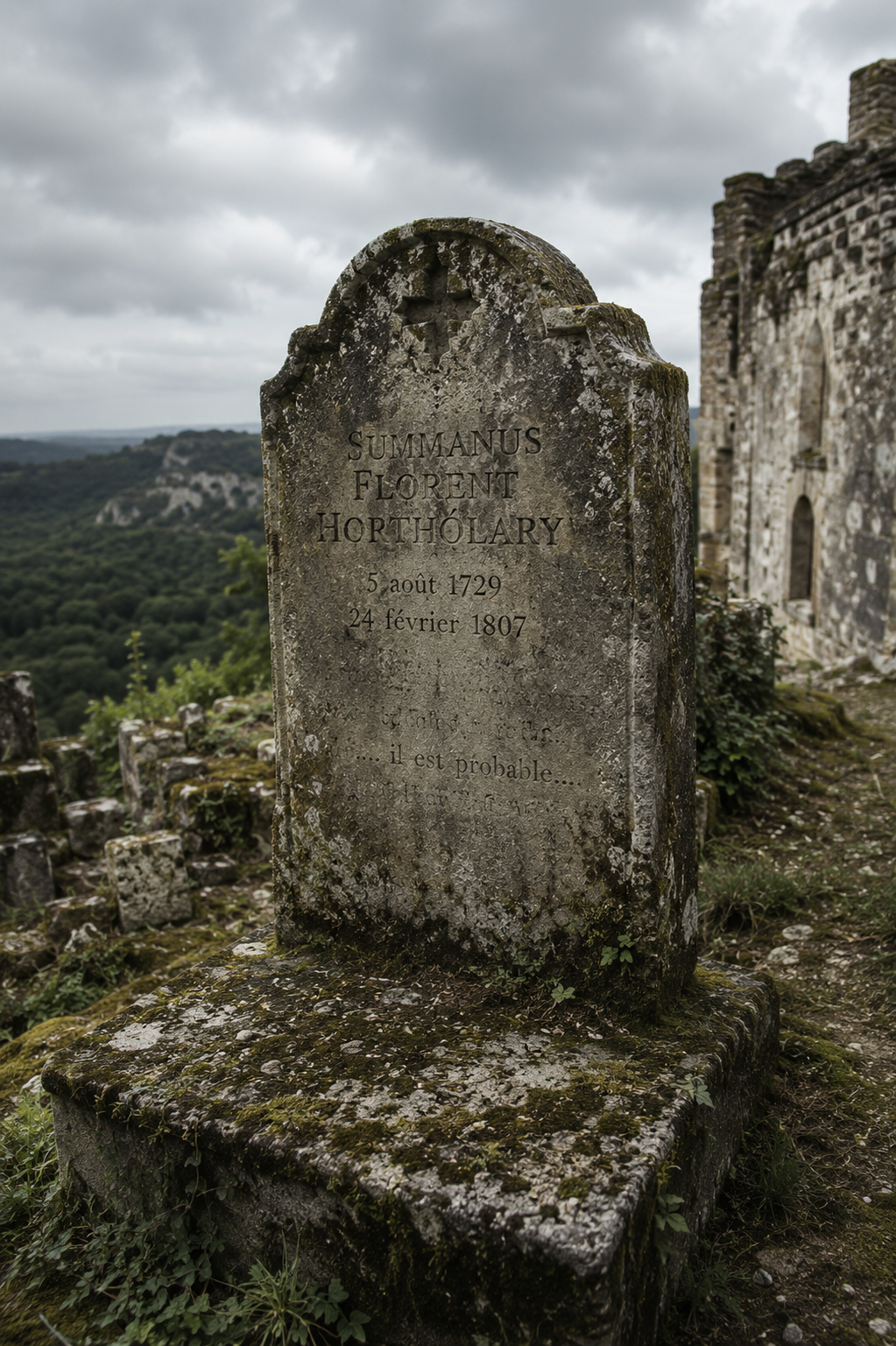
Photograph of the headstone at the Prieuré de Saint-Hugues-de-la-Précipice, Cazaux, Maladie, France. Image The Tricky Genre Press 2026 (see Notes for full credits).
One point of clarification: the grave itself is not located in the priory’s crypt (to which the extract you have so cunning dissected refers), but is, instead, in the adjacent cemetery. To this we may add that on the reverse of the photograph is a handwritten annotation which runs as follows:
“3rd Row fm the wall; inscription badly weathered “…. it is probable….” Sprig of dried juniper left recently.”
Notes
The image ‘Photograph of the headstone…” was created using ChatGPT.
