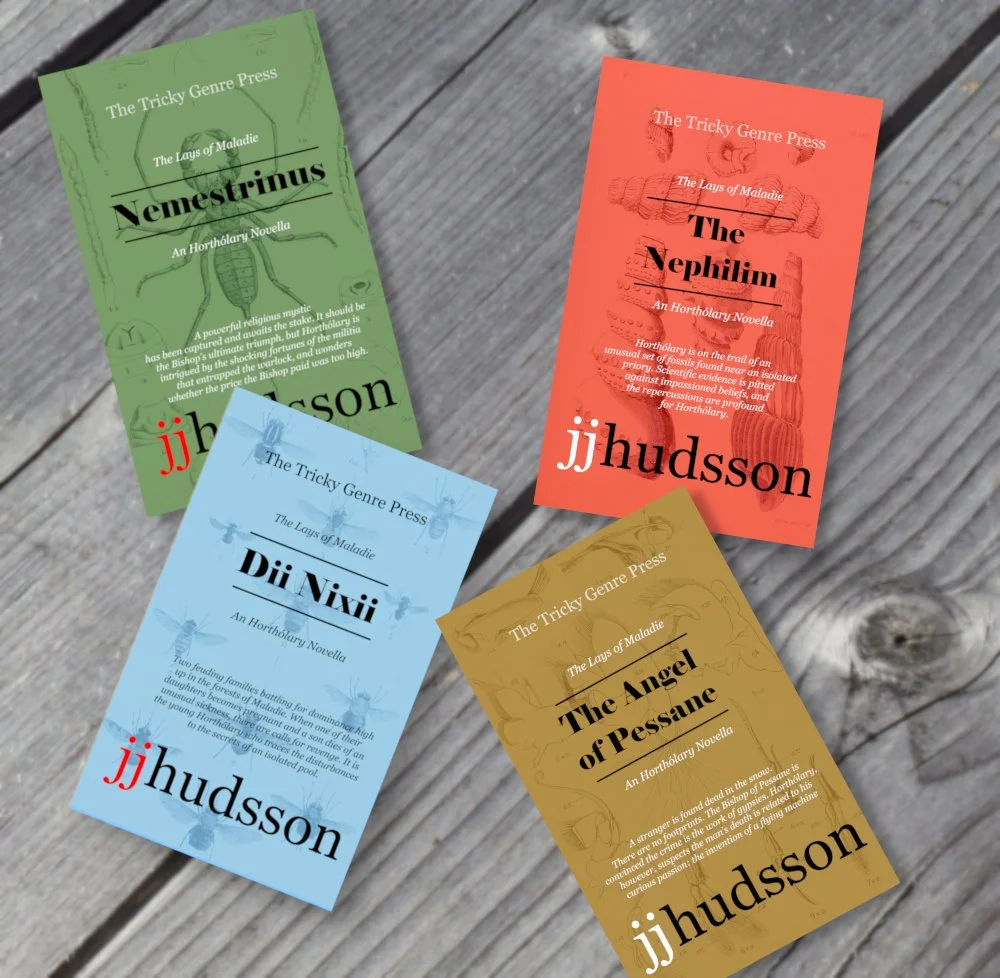
The Nephilim
Prof. Horthólary is on the trail of an usual set of fossils found near an isolated priory. Scientific evidence is set against impassioned beliefs, and the boundary between myth and reality is blurred. Do you believe in giants?
Read a sample
-
THE BOY DARTS behind a holm oak. He presses his back hard into the rough bark, feeling the craggy skin score his own, and tries to control his bursting lungs from noisily gulping in the air. Between heaves he strains to listen. Further down the lightly wooded slope the sweeping crackle of the understorey being crushed and brushed aside has not diminished; his pursuer has his scent. The boy - who is no more than six years of age - wipes a tear from his eye. Ahead, through the outcrops and ferns, he spots a dark opening in a bluff of limestone. A cave! If he can reach it he will be safe. He cranes his head and peers around the oak. The slope below is silent, save for the telling cry of a jay. He imagines the beast sniffing the clean springtime air, seeking out the intoxicating scent of warm blood and cold fear. The cavern is a short sprint up the hillside, but the path to it is dotted with oaks and mulberry bushes and outcrops of limestone. In his head he counts out his paces through the thigh-high ferns. One, two; five, six; eleven, fifteen. He can make it, if ...
There is the crack-shot of a dry twig snapping below him, to his right - not twenty paces away. The beast is out-flanking him! Panic-stricken, the boy does the worst thing he can do. He springs from his hiding place like a startled deer, and with all his might makes for the cavern.
In the open, exposed to the clean sun, the ferns throw themselves in his way and catch at his heels; sprigs from the oak saplings whip his chest and the limestone boulders hidden in the moss and grasses trip him up. He falls, gets up, staggers on again. But now a shadow is looming over him. The entrance to the cave is still two dozen paces ahead. He feels something flick past his ear. If he can reach the next boulder he might duck behind it. But just as the thought leaps into his mind his ribs are clamped in a vice-like grip; his feet are torn from the ground.
The deep blue sky, spotless and fresh, wheels across his horizon - then the tops of trees and the warm mouldy earth. He is flung upside-down, hoisted up and over. He lets out his biggest, highest scream and wriggles his body like a rudd caught hard upon the pike.
-
GIANCARLO HAS HEARD many tales of the hills and caves around Cazaux since he arrived at the Prieuré de Saint-Hugues-de-la-Précipice. That was a year ago. He was escaping something then. Now he merely exists; or, at least, he used to just exist - before they came into his life.
Back then there were only a dozen brothers in the community, all of them men from the Pays Maladie, and although the Order was nominally a silent one nonetheless they found ways to tell him their tales. What else was there to do? Cazaux lies atop an isolated promontory high above the sparsely populated valley of the Varges river. Apart from the small cluster of houses that had over the years sprung up around the Priory walls, there was hardly a soul in leagues. The brothers were men who had chosen a life of contemplation - regiment; a life of poverty both in body and sense. They lived only in their minds. For some this meant a euphoric sojourn in the Divine gardens where no issue, it seemed, was too small or inconsequential for lengthy missives from the Maker. For others - Giancarlo among them - it meant lonely and unanswered confinement in a godless garret, filled with the bric-a-brac memories of other lives and other faces, but without, it was becoming apparent, any communication with God. For these men the only escape was to talk, and they became expert in the art of cramming a stream of ideas into a few short snatches of conversation by the ovens, the well, or in the orchards that ran down to the falls. This was how he discovered what the brothers knew of the Nephilim.
“My grandfather was one of the last men to see one,” a brother as old as the hills told him. “Up yonder, under the shadow of the edge. As tall as two men he was, and dressed in a cloth that shimmered like water.”
It used to be said that the Nephilim belonged to an ancient people so feared and fierce that even the saints could not tame their hearts. No one knew where they came from: from the north, some said, with the horsemen who travelled over the Great Plateau centuries before. Others claimed that they grew out of the limestone pillars that ran along the edge, with souls of stone forged by a sorcerer’s spell. All were agreed, however, that the Nephilim once held dominion across the Basse-Maladie. And all concurred that they were a race of giants.
A curious mastery it must have been, for the Nephilim seemed to possess little in the way of art or industry. They built no villages and ploughed no field. You will find no shards of their pottery lovingly restored in the University Museum at Pessane; no carbuncular iron-work hung across farmers’ hearths; no strangely wrought metal dangling from the ears of wealthy Maladol. It is as if the Nephilim didn’t want to leave their mark upon the land. Maybe they were hiding from someone - or, perhaps, from something.
But you cannot hide a people, even in the labyrinthine wildwoods of Maladie; less so when those people happen to be of gigantic stature.
The Romans, of course, found them. When their legions saw the giant men watching them from the limestone Edge and from the fringes of the wildwood they grew afraid, and the fear swept like a contagion through their ranks. The Roman consul who led the imperial thrust into the Pays Maladie was called Quintus Fabius Maximus. He was a cruel and vain man, beholden to glory and bent on achieving victories for his supporters in Rome. He ordered that this strange people should be subdued, harnessed and yoked into the protection of the Empire. What he meant, of course, was that the Nephilim should be annihilated; if not wiped off the face of the earth then at least utterly decimated and scattered to the four corners of it. He would spare a few leaders and some of their young women. The men he would parade, shackled and caged, through the streets of Rome to show how fierce these Nephilim were and how brave he was to have conquered them. As for their extraordinary women - tall and powerful - he planned to give them as slaves and concubines to his patrons. All this would he cause to be written down in the Histories. Quintus was not only cruel, he was also full of cunning. He quickly saw that these giants were no battle-hungry warrior tribe, for although they were of immense stature they were entirely without guile. Indeed, the art of warfare seemed alien to them. His scouts reported that they did not carry weapons and their settlements (such as they were) were undefended.
“But they are giants, Imperator,” his officers cautioned. “The men, they are afeared.”
“If giants they be, then with giants of mine own shall I meet them,” Quintus told them. “This shall be a battle of giants!”
The giants the General had in mind were not men, of course, but animals. Quintus had a dozen elephants from the colonies in North Africa with him. They were not well-trained creatures of war but clad in armour and with banners and streamers fluttering from their backs they made a dreadful impression on the primitive woodsmen of Maladie, who were armed with nothing more powerful than a hunting bow. With these massive beasts lumbering ahead Quintus swept the South of all resistance. When he came into the land of the Nephilim he was already preparing his Triumph for when he returned to Rome. A few of these native giants were just the spectacle he had been looking for.
But every great Consul loses a battle eventually. Maybe not on the field, but somewhere in his life, his office or in his bed he nurses a defeat. Quintus had his Triumph in Rome, and it was highly regarded in its day. But there were no giants in the parade of captured kings and exotic plunder. His History records no “battle of giants”. Indeed, it seems doubtful there was anything more than a few running skirmishes. Quintus’ chronicler tells us merely that:
“...The tall people of these parts hide in caves rather than fight and are seldom seen.”
Were it not for one fact, it would be easy to discount the Nephilim of Maladie as nothing more than folklore. The old monk, whose grandfather claimed to have seen one, took Giancarlo to the small room in one corner of the Priory that passed for a library. From a high shelf he heaved down a great book with heavy wooden boards. Finding the page he desired, the old monk pointed to a finely engraved illustration.
“That is the sculpture that was made on the triumphal arch Quintus had built on the Via Sacraat in Rome,” he said pointing to a flat procession of ghastly figures brandishing all manner of weaponry. “It has since been destroyed, but see - the Arvernians and their king Bituitus.[ The Arverni were a Gallic people dwelling in the modern Auvergne region during the Iron Age and the Roman period. Bituitus was their king.] And here,” he pointed to two figures on the far left of the illustration: they were clad in what might have been armour or some stiff cloth; each carried a staff from which several light-like rays emanated; but the most distinctive feature of the figures was that they stood almost twice the size of the Roman soldiery surrounding them. “Here,” pronounced the old monk, “are the giants of Maladie.”
“Stop it! Stop wriggling I say! I might drop you! Your feet are dirtying my dress!”
The boy is righted and gently placed upon the soft forest floor, whereupon he is devoured by nothing more deadly than the delightful wholeness of his mother falling over him, her long tresses cascading over his face, his nose pressed tight into the milky warmth of her bosom. And then he is tickled across his ribs until he has pleaded for mercy and promised to give ‘the Beast’ fresh bread and straw and milk every day thereafter. Exhausted, the boy and his mother lie on their backs in the sunshine until they can regain control of their panting breath. They look up through skinny branches that are just smudged with green shoots, the first of the spring. After the long winter and, to the boy, the even longer wait for the settling-in of the season, they are both a little drunk on the crisp air and the clean smell of life bursting out of every twig and bole. It is their first adventure together into the hills since the far away autumn.
“Can I play in the cave now?” the boy asks.
His name is André. His mother knows already, even though she is only twenty herself, that he will be the only son she bears.
“Yes,” she replies, wishing he would stay with her a little longer. She tussles his long black hair. “But mind there are no bears still asleep in there. The Big Wolf is still at the bottom of the hill and he won’t be able to save us if you wake one.”
“Don’t worry, mama,” the boy shouts over his shoulder as he runs off through the trees. “If there is a bear the Big Wolf will hold up his staff and save us all!”
She sees much of his father in him: in the way he moves, in the way he thinks. He is efficient and uncompromising, wasting nothing. These are the hallmarks of the woodsman. The woman smiles. She misses the wildwood: The Basse-Maladie with its bocage and farms is too tame for her. Like the boy she, too, has been waiting for this moment - the first real day of the spring - to get out of the village and into the hills behind the Priory. She stretches out on the warm grass. Beneath her the earth is still a little moist from the thaw; in another month it will be as hard as wood and taking just a few steps will be enough to throw up a cloud of dust that can be seen from the Falls. But today even the newly budding oaks are conspiring to conceal them. She smiles again and wiggles her feet from side to side. No one knows they are here.
Nevertheless, she has taken the precaution of travelling ahead of the man whom she and boy call ‘Big Wolf’. If one of the monks were to spot them together or, worse, that old owl of a Prior, who knows what would happen?
A snatch of a familiar song reaches her ears. It is coming from further down the slope. She props herself up on her elbows and peers through the trees and ferns, but quickly loses interest and finds herself studying her own slender body laid out in the sun. She hitches up her smock a little to reveal a stocking. It is true that she is slightly built but her confident demeanour makes people think she is stronger than she is. What most people notice first, however, is her cascade of unruly red hair which, against the custom of the village, she insists on wearing down, gathered with a ribbon at the nape of her neck. She does this because she knows it is wrong. It is what attracted Giancarlo to her.
“Grieve now,” he had told her when they buried her husband the previous winter. “But in the spring wear your hair down.”
Strange words with which to comfort her.
“Will you come?” She had asked him, before she knew what she was saying. It was often her way. She says things not because she believes them but because they seem appropriate for the moment. Words, she thinks, have their own space and time; some are exquisitely crafted for a particular point in our history, so how can she regret these bold words? His hurried look away tells her that these words are merely of their time.
One day, towards the end of winter, she sees his tall frame coming by the little garden she tends. He has a cloth under his arm.
“I’ve been swimming in the lake,” he calls to her. His closely cropped silver hair is as damp as an otter pelt. “There’s a little pool in the valley yonder.”
“Isn’t it cold this early in the year?”
The snow has not been gone for more than three weeks.
“By Saint Sebaldus it is!” He exclaims.[ Saint Sebaldus is a vague figure. He is venerated as a woodland hermit. In one of his miracles he turned icicles into logs for a fire.]
She sees how his eyes twinkle. “It’s freezing, but it cleanses both the body and the soul, Madame.”
They both laugh. She puts a hand to her lips and he notices how white and long her fingers are.
That is how their strange love takes hold. He is much older than she, perhaps fifty; his dark brooding eyes seem well matched to his grey robe. That is how the André gave him his name - Big Wolf. She is not devout or fussy like the other women in the village; indeed he doubts she is even a believer - at least in anything he can understand. But there it is. She finds herself whiling away the indecisive days of March waiting for each of these oddly contrived meetings.
“Hie!” comes a breezy call from the lip of the slope. A figure working its way deliberately between the oaks towards the glade. “There you are! Didn’t you hear me calling?”
The girl smiles but doesn’t get up. Instead she waves one arm in greeting. At length the man emerges into the glade by the cave entrance. He is wearing the grey robe of a Pontifice monk. He unshoulders a heavy looking satchel and looks about him.
“Well!” he exclaims happily. “This is certainly a beautiful spot you’ve found.”
In all the long days of the Seed Moon they exchange no more than a dozen-score words, but nonetheless the love grows within them: she can sense it and allows it to flourish, nurtures it even. He, on the other hand, tries to pretend it is something other than it is; he makes believe he is doing God’s duty rather than his own as a man.
“Where’s the boy?” he asks, looking about him. From up here he can see southward down the little wooded ravine through which he has recently travelled to the Falls - La échelle d’âmes, as the Maladol call it; the girl left him a flagon of wine there and a ribbon upon a rock. He had enjoyed the warm taste of the wine and the refreshing spray of the Falls that settled on his face. Turning due west, nestled comfortably between this prominence and a lower one upon which the Priory of Cazaux stands, he can make out the little lake where he swims, glinting between a smattering of ash trees; and beyond, the mercurial sweep of the Lower Varges slipping silently south. Stacks of smoke rising from distant Cazaux (a world away, or so it seems to him) reminds him momentarily of his predicament, but barely dents this euphoria.
“He’s exploring the cave,” replies the girl. “Hoping to find a bear or some other beast.”
Giancarlo laughs.
“I hope not!” he says as he sits stiffly down beside her, his long legs dwarfing her own pale flesh. She flattens her skirts back over her calves. He does not notice. He casts a doubtful look at the brooding opening behind them … there are tales in these parts, as everyone knows.
It is some hours later, after they have shared the modest picnic (he provides freshly baked bread from the Priory, she some cheese and a little wine she has traded for spring vegetables from her plot), and the boy, who has only been lured out of the cavern by some aniseed the monk has saved especially for him, has eaten as much as his mother has been able to persuade him to. He has seized the aniseed and popped it into his mouth with wide eyes. It is only then that he shows them what he has found.
“What’s that you have there?” Giancarlo asks.
The boy, still chewing on the bitter-sweet morsel, looks disinterestedly at the dirt-encrusted object lying on the grass beside him. It is as long as his arm, chalky white in colour (although still half covered in a clay-like casing) and roughly triangular in outline.
“I found it,” he replies nonchalantly between long sucks of the tarry sweet. “In the cave.”
Giancarlo picks it up and examines it.
“It’s a bone.”
There is a mischievous sparkle in his eyes. His devotion to his calling is more or less absolute (this lapse will soon pass, he thinks, once the creature beside him has found herself another husband). But this does not mean he has not reserved a little part of his soul for devilry as, he believes, every honest pilgrim should. Here dwell the orphaned children of his imagination - the dragons, monsters, witches and warlocks of his youth. He turns the bone over in his hands. It is deceptively light for its size, as if filled with air. “Perhaps it is the bone of one of those Romans, André!” he whispers conspiratorially. “Think - it might have lain up here undisturbed since the time of Quintus Fabius Maximus!”
With delicious release he lets the demons run riot.
“Don’t be silly,” interjects the girl. She has no time for folklore and fairy-tales, not when there is a living to eke out and with no man in the house. “It’s probably just a wolf or a wild cat...”
“Or a bear,” chirps the boy optimistically.
The monk studies the bone doubtfully.
“It’s too big for a wolf or a bear,” he muses.
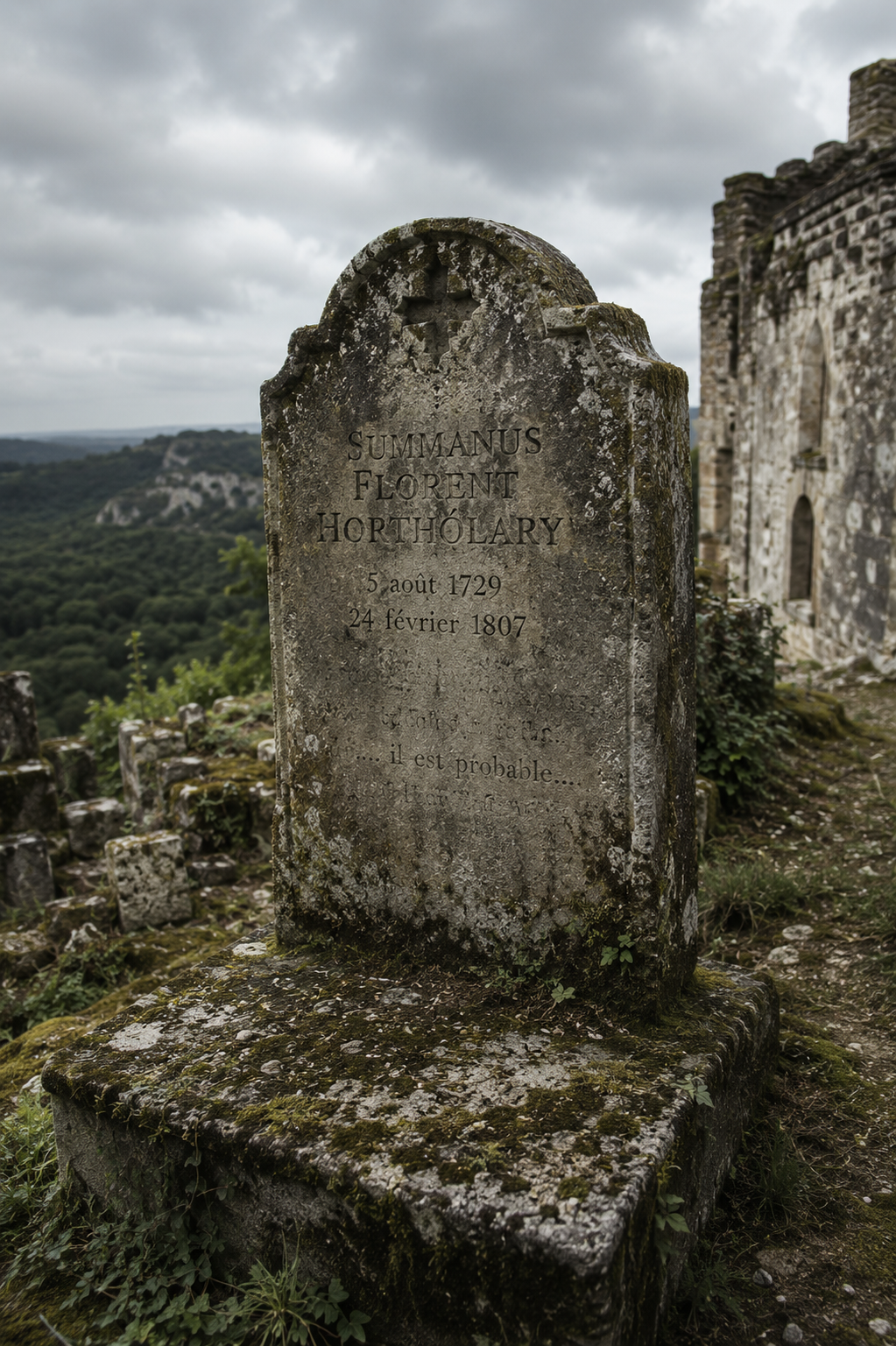
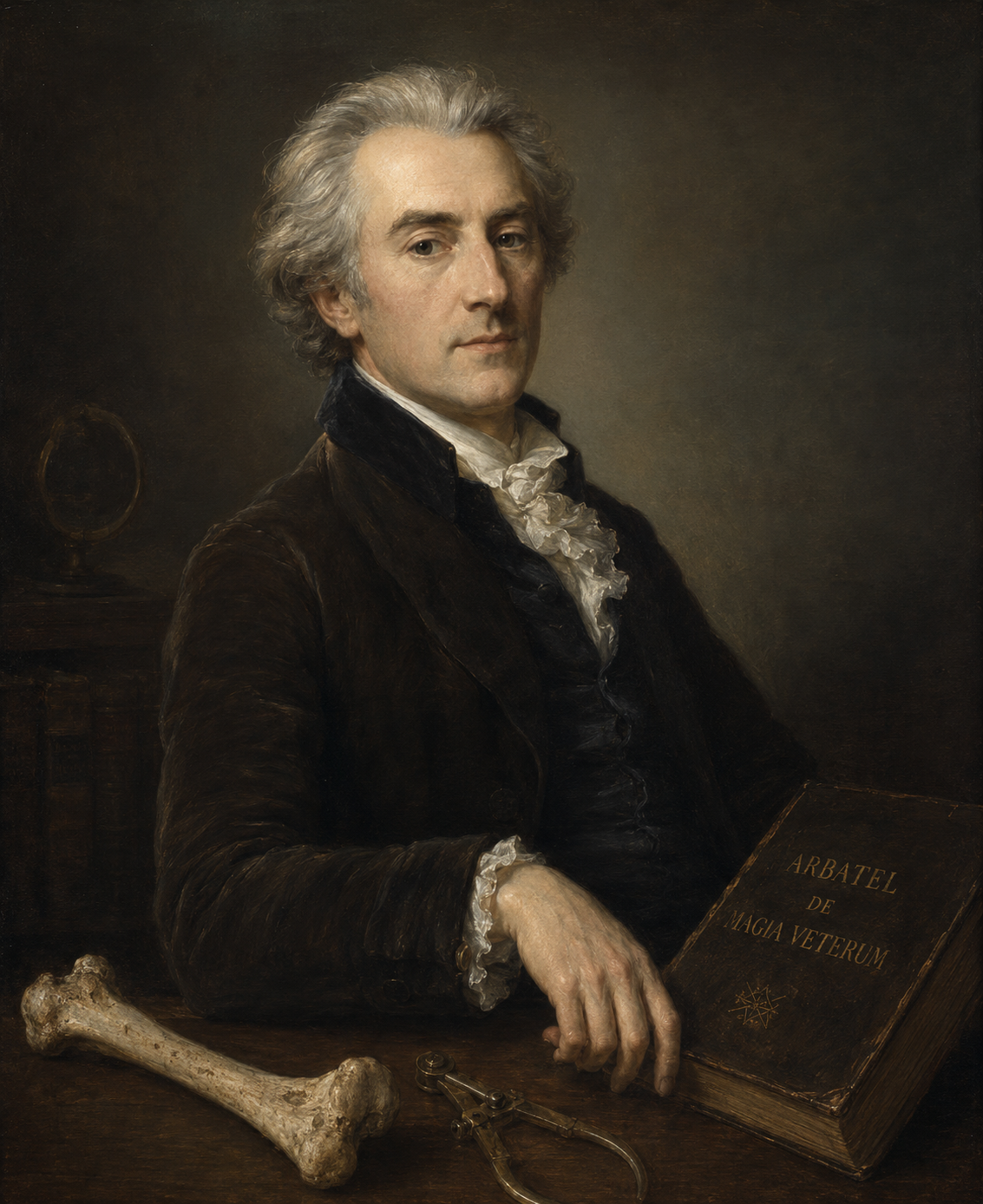
There was a young man who had stayed at the Prieuré de Saint-Hugues-de-la-Précipice last summer, he recalls - a professor from the University at Pessane, devout and diligent. He was interested in bones and had travelled up to Cazaux to explore the rocks along the edge. He said they must be as old as the Flood, for he had found the remains of sea creatures among them. Giancarlo had seen them with his own eyes. The professor had asked the brothers if they knew of any unusual bones from along the edge and had asked them to send him anything interesting they happened to find; he had left a name and an address. “I think I’ll send this to him,” he tells the boy as they pack up for the journey back to the Priory. “You never know. Maybe it belongs to one of Quintus’ elephants...”
On the journey home Giancarlo stops in his tracks. They have descended the gentle slope in front of the cavern and reached the steeper gorge of the little brook that runs due south to the Falls. Here the rough limestone breaks out of the mountainside and the holm oaks eke out their precarious existence, misshapen, stunted and set at impossible angles out of the living stone. The three travellers are still a good height above the stream and can scarcely hear its impatient rushing through the trees below them; indeed, up here all noise of the wildwood succumbs to the silence of the ravine: jays and crows let them pass unheeded; only the brittle stems of last season’s ferns snapping under their feet mark their passing.
Giancarlo cocks his head and scans the slopes above them. He has that sense of being watched: the quivering of hairs at the back of his neck, the reaching of eyes deep into his soul. The girl, however, weaves on between the outcrops and boles, her dress rasping on the grasses. Every now and then it catches on a bramble and with a graceful sweep of her arm she teases it free. She senses nothing. But the boy - André - he is looking intently at a point beyond the monk’s shoulder, back towards the cave.
“Forgotten something?” Giancarlo asks, knowing as the words are uttered that they are merely an expression of his own concern.
The boy shakes his head; but still he looks north in the direction of the Edge.
“Not forgotten,” the boy mumbles. “Taken - I think that we have taken something that belongs here.”
-
Prologue
The Fossil
One Footprint in the Sand
On the Road to Cazaux
La Prieuré de Saint-Hugues-de-la-Précipice
The Stranger with a Light
Journey to the Edge
In the Crypt
The Egregore
Epilogue
-
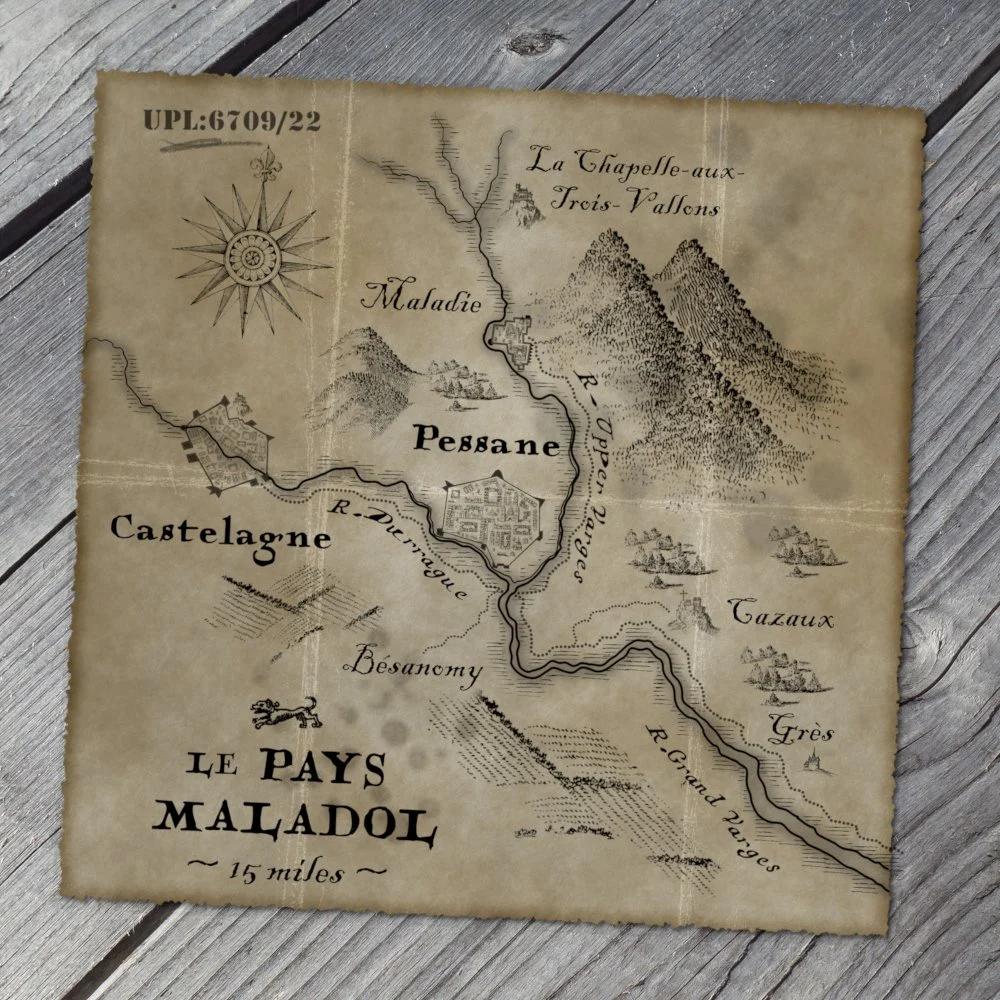
Map 1. Le Pays-Maladie. Map of Maladie region c. 1752, showing the principal locations mentioned in the text (Image: University of Pessane).
Map 2. Prieuré de Saint-Hugues-de-la-Précipice, Cazaux. The Lower Varges & Cazaux, Pays Maladie, c. 1760 (Image: University of Pessane).
Returning to his days as a student at the University of Pessane, The Nephilim has Horthólary on the trail of an unusual set of fossils found close to an isolated priory belonging to an impoverished religious community. The tale pits scientific evidence against impassioned beliefs and has repercussions that will be profound for Horthólary and familiar to the reader.