A Leaf out of a book
Could this be the earliest evidence of HUMAN flight?
Regular readers of The Tricky Genre Blog will recall that recently the industrious equilibrium of the Press was disturbed by a letter requesting a photograph of Horthólary’s grave. The languid search of the premises this request engendered not only turned up the photograph but also two items of Horthólary archive that - and we are being generous here - the Storyteller appears to have forgotten to return to the University Library at Pessane.
Under the Churchillian aphorism to Never Let a Good Crisis Go to Waste, Tulip - who found both the overlooked items - suggested we post a blog on them, as both documents are quoted in two of jjhudsson’s Horthólary novellas, which The Tricky Genre Press has just e-published.
Here, then, is the first document - found wedged under the photocopier.
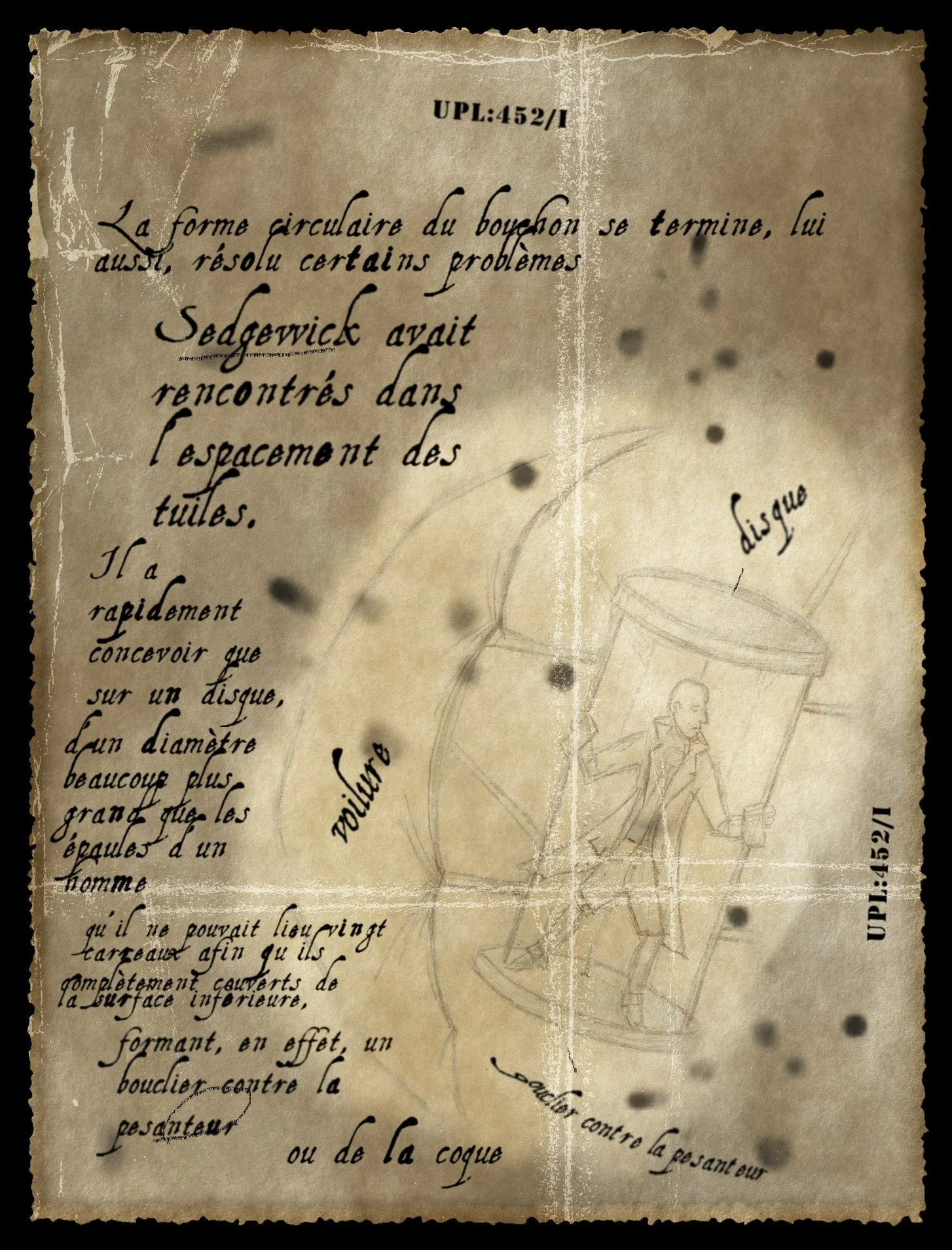
Page from the journal of Summus Hortholary, dated c. January 1777. Image: The Tricky Genre Press (2026).
It is a leaf which I have been told not to say looks as if it has been torn out of the original folio. It measures 673 mm by 512 mm and bears the accession number UPL: 452/1. The verso is blank. Unusually for an Horthólary autograph it has not been encrypted. The French text - in Horthólary’s own hand - is plainly legible and can be translated into English as follows.
“The circular shape of the stopper also solved certain problems Sedgewick had encountered in the spacing of the tiles. He quickly conceived that on a disc, with a diameter not much larger than a man's shoulders, he could place twenty tiles so that they would completely cover the underside, forming, in effect, a shield against gravity or the hull…”
The name Sedgewick (“… certain problems Sedgewick had encountered…”) immediately places this document at the time of the First Lay of Maladie - The Angel of Pessane - dated in textu to the winter of 1776-7. While the context of the lines requires little to lead one to conclude that the subject is none other than the mysterious ‘flying machine’ there described:
“You don’t mean to say that you have actually built this machine?” the professor began. “I mean, one large enough to take a man? To take - you?”
“But my dear Professor,” scoffed Sedgewick, with equal incredulity. “Why else do you suppose I have invited you here?”
And he opened the door that gave onto the courtyard. “See for yourself!”
What is even more exciting about this document is the faded image on the right-hand side of the folio. It is a pencil sketch depicting a cylinder containing the figure of a man. There are three handwritten annotations: to the left, where there appears to be some sort of extension attached to the cylinder, is the word ‘sail’; at the top, above a circular plate, the word ‘disk’ appears (there is a matching disk at the other end); and beneath the figure’s feet the words ‘shield against gravity’ are written.
There can be little doubt, surely, that this is a contemporary sketch of the machine described in the Angel of Pessane. If this is indeed the case, then, following the descriptions in the Lay, the disks contain those strange tiles excavated by the Palbanites, and the sails (there is the suggestion of a parallel device on the opposite side), are made from the Breton flour so valued by Robert Sedgewick.
Perhaps it is no wonder, then, that the Storyteller ‘forgot’ to return this particular part of Horthólary’s journal - it just might be the earliest evidence of human flight. We, on the other hand, will be making a landing (or a return) as quickly as possible!
Notes
The background to the blog cover image is ‘Weatherworn top of wooden table’ by W.carter, CC0, via Wikimedia Commons.
The image “Page from the journal of Summanus Horthólary…” is hand-drawn by the author.