Message in a bottle
Take care to approach unseen and unheard
Part 2 of our series of ‘recently re/dis-covered’ Horthólary archive is a real gem. Tulip found this particular document rolled up inside an empty bottle of Svalbard red which had fallen behind the sofa in jjhudsson’s office. We assume that the resemblance to a Molotov Cocktail is passing, although it is interesting to note that there were two other similarly augmented bottles (sadly, neither one fused with original archive), and it must be admitted that Pointed Mountain Merlot does leave a faint smell of petrol when dried.
It is a letter, or note, in Horthólary’s own hand, addressed to Félix Gélis, the young Sénéchal of Pessane. Although it is undated, the contents suggest it must have been written in Castelagne on the 28th November 1801, assuming jjhudsson’s account of the execution that took place in Castelagne is correct.
That account is memorably retold in his novella Nemestrinus [Ed. available to download for an insanely reasonable price from this very website]. If you haven’t yet read the full account, we won’t spoil it for you; other than to say that as archbishop Rapin prepares to burn the famous Nemestrinus, Horthólary finds himself enmeshed in the mystery of how the bishop managed to ensnare the elusive Maladol warlock. As time runs out for the condemned man, Horthólary, on the cusp of understanding the fatal bargain that has been struck, pens this missive to the son and heir of his old friend Jean Gélis:
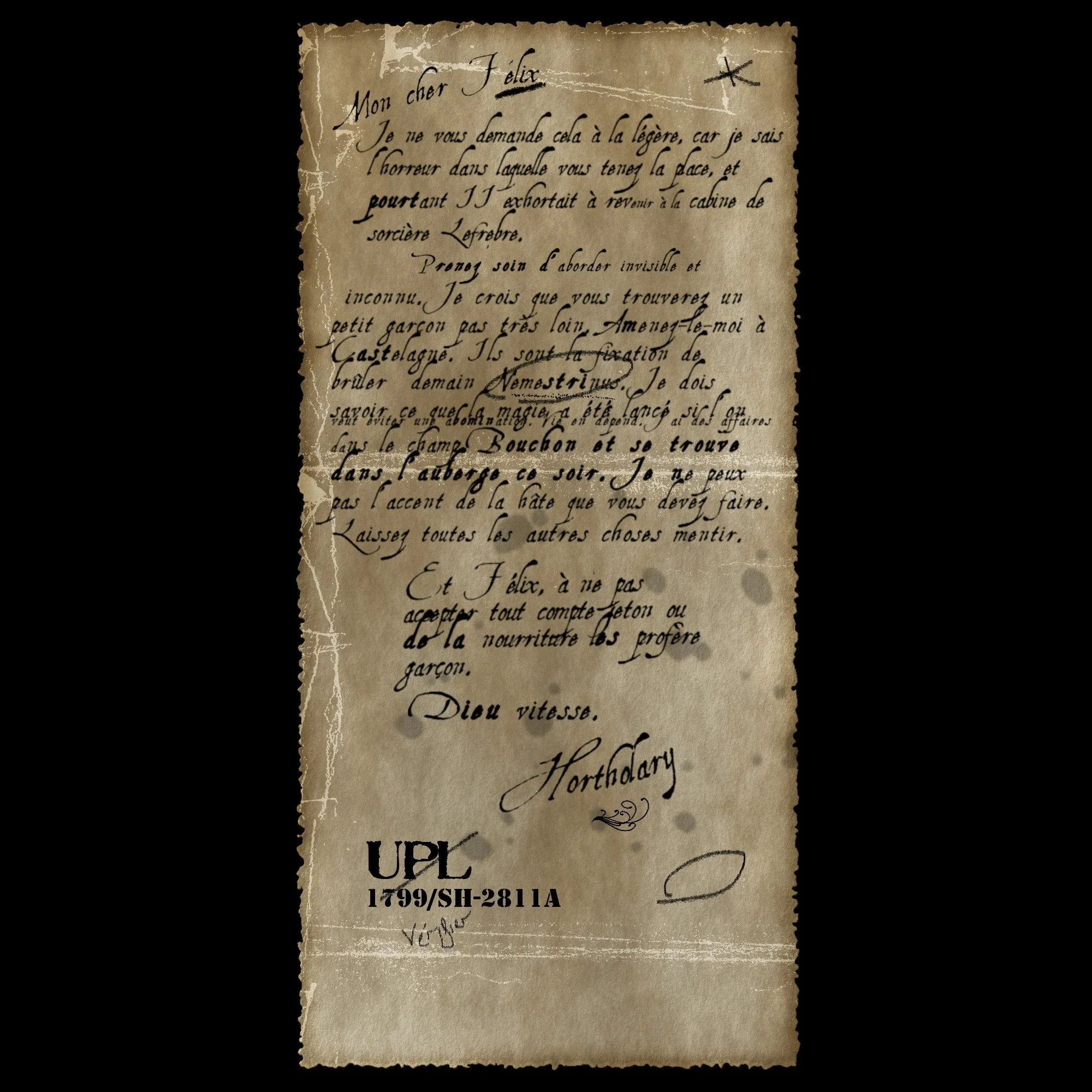
Letter from Summanus Horthólary to Félix Gélis, dated c. 28 November, 1801. Image: The Tricky Genre Press (2026).
“…I do not ask this of you lightly, for I know the horror in which you hold the place; and yet I beseech you to return to Witch Lefrebre’s cabin…”
This is a reference to the location at which the tale begins, one damp autumn morning high-up in the Haut-Maladie, and the dreadful scene that is discovered there. The writer goes on to caution:
“…Take care to approach unseen and unheard. I believe you will find a young boy not far off. Bring him to me at Castelagne.”
Here is direct evidence of Horthólary’s location at Castelagne when the letter was written. For the import and fate of the young boy mentioned you will have to read the full story, but if anyone is in doubt about what is at stake the next lines are unambiguous:
“They are fixing to burn Nemestrinus tomorrow. I must find out what magic has been cast if we are to avoid an abomination…”
According to the Parish Calendar kept at Pessane, the execution of Nemestrinus took place on 29 November 1801, which gives our autograph its date of one day earlier - the 28th.
The urgency with which this letter is imbued is further argued by the fact that it is in Horthólary’s own hand. The professor, in keeping with his place and time, copied both incoming and outbound communications into his personal archive. Regular readers will know these copies were also encrypted using the professor’s uniquely complex cipher. However, this is not the case with this missive. There is no record of the letter in the sixty-six surviving Horthólary journals kept at the Universities of Pessane and London, nor in the three main private collections (Ed. See the Preface of The Lays of Maladie for more on the sources of the Horthólary tales). And clearly the letter has not been enciphered. Both these aspects lend credence to the urgent nature of the communication.
Horthólary ends his letter with this injunction to the young Felix:
“… And Félix: on no account accept any token, food or drink from the boy…”
He is, of course, right to urge caution, as the tale reveals. For the sceptics among our readers, we merely suggest that if you ever find yourself in the Office de Tourisme at Castalagne - study the floor!
Notes
The background to the blog cover image is ‘Weatherworn top of wooden table’ by W.carter, CC0, via Wikimedia Commons.