Biblio-mythology
You heard it here first
It’ll be like when President Kennedy was shot, or when the Grave Robbers broke up - you’ll remember where you were when you heard it.
For some time now the staff of The Tricky Genre Press have been wrestling with a tricky editorial problem of our own: how to present certain information that the Storyteller jjhudsson has included in his latest novel, Other Places Which Also Are the World’s End?,information that features in passages like the one below, which appears at the end of Chapter Seven. Menlo and Deal have arrived at an isolated cabin deep in the fogs of the Cloud Well:
“Back inside Lighterman’s cabin I ate some food and listened to the howl of the wind outside. I’d seen a shelf of Old Earth books in this cabin during my initial sweep of the compound, and after I had eaten, I took a closer look, running a finger along the dusty spines. They were mostly scientific journals. I took one well-thumbed volume out and turned to the article marked with a faded post-it note: Nature Communications, volume 330, (2038), pages 67-72, ‘Negative energy sphere transits a Lorenz bridge’ by Rigas, C. The text was heavily annotated in an untidy and chaotic hand…I had this in my hand when the wind outside the cabin abruptly died….”
Or this, from the following chapter, concerning the Press’s favourite philosopher:
“…I will not pretend that I understand St-Jean Guillaume's way of thinking. He was best known for his work on time-travel, which is why I say you may have come across him; before the Collapse his books were widely plundered by the science fiction writers and film auteurs of the day. But apart from some conjectures on temporal paradoxes (where it seems anyone clever enough to make a time-machine would also be a suicidal maniac intent on murdering their parents), I knew nothing of his work. I certainly hadn’t troubled the pages of On the Nature of Man as a Multi-Planetary Species (Sorbonne Université Press, 2065), which is the seminal text on the ethics of interstellar transit. In as much as I had given these things thought, it was to offer that surely there are better things to do as a time-traveller than murder one’s parents and in so doing to condemn oneself to oblivion…”
What both passages have in common is that within them jjhudsson cites an academic text. The initial question was how to deal with this material without ruining the flow of the novel.
“Why don’t we just add a bibliography?” Was Angus’ very sensible suggestion. Well - it was a sensible suggestion, until we discovered that neither of these publications actually exists.
It turns out there are about a dozen books and research papers cited in Other Places that jjhudsson has made-up. Despite the authentic-looking citations, no such publications exist (yet).
There is a further wrinkle. While some citatations - like the St-Jean Guillaume’s text mentioned above - refer to tangential aspects of the story, such that the reader might not distinguish them among the general flow of the narrative, others are more pertinent and, to the discerning reader, even essential to the plot.
This is particularly the case with a series of nine research papers, the citations for which we found scattered throughout the MS of Other Places. Not only do these references appear complete and authentic, they are also accompanied by an abstract outlining the research presented within them. To every sense they appear authentic. But not one of them - as far as we can tell - has ever been written.
The titles and abstracts of these papers, together with the twelve fabled meetings of the International Conference on the Physics of Interstellar Transit (ICPIT), reveals the entirety of research into interstellar travel as conceived by jjhudsson for Other Places. They range from the granite shores of a genuine research paper published in 2023, across a speculative ocean of fictitious breakthroughs and academic controversies, all the way to the eve of global disaster some fifty years later.
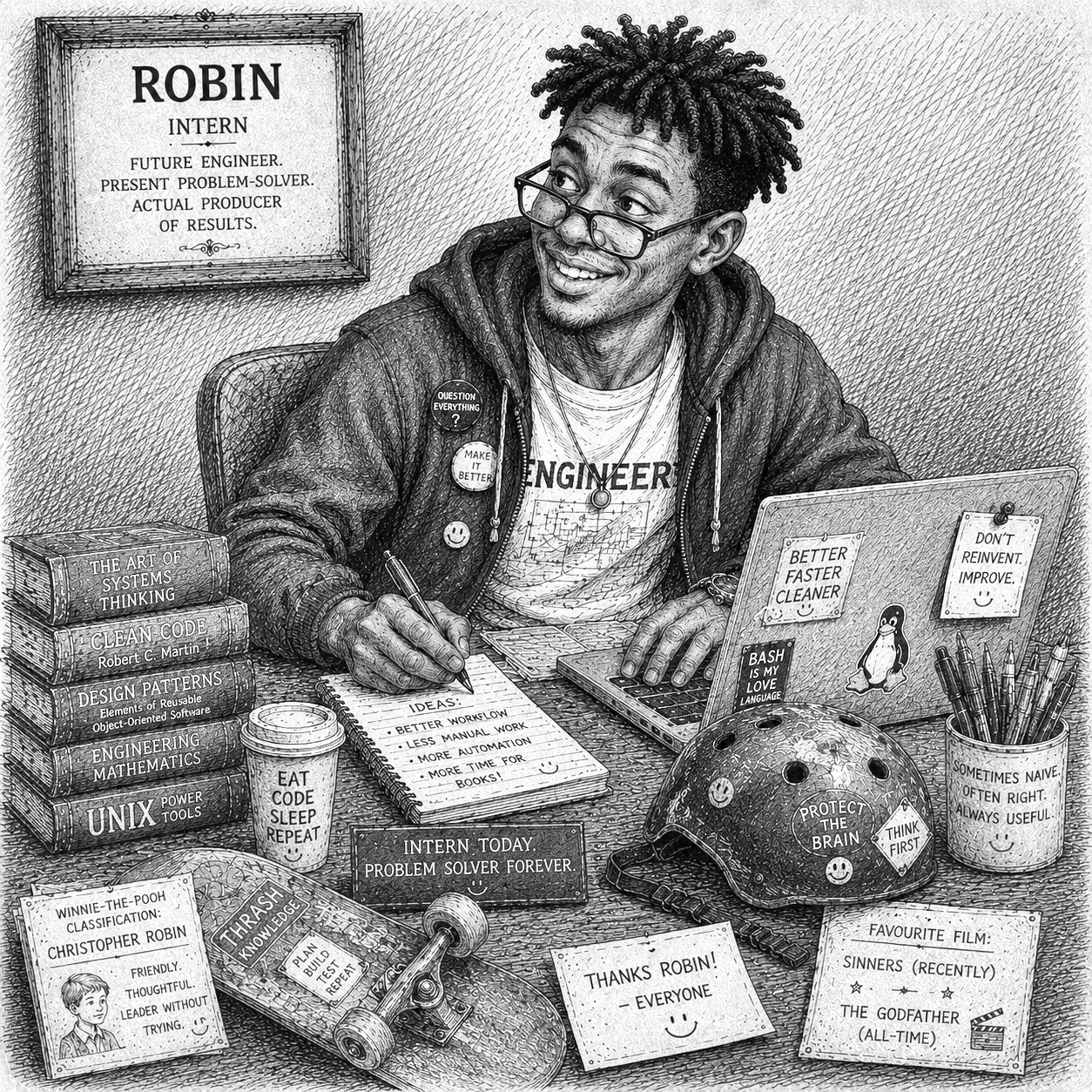
The wonderful Robbie, the Press’s intern, has collated all this into a table:
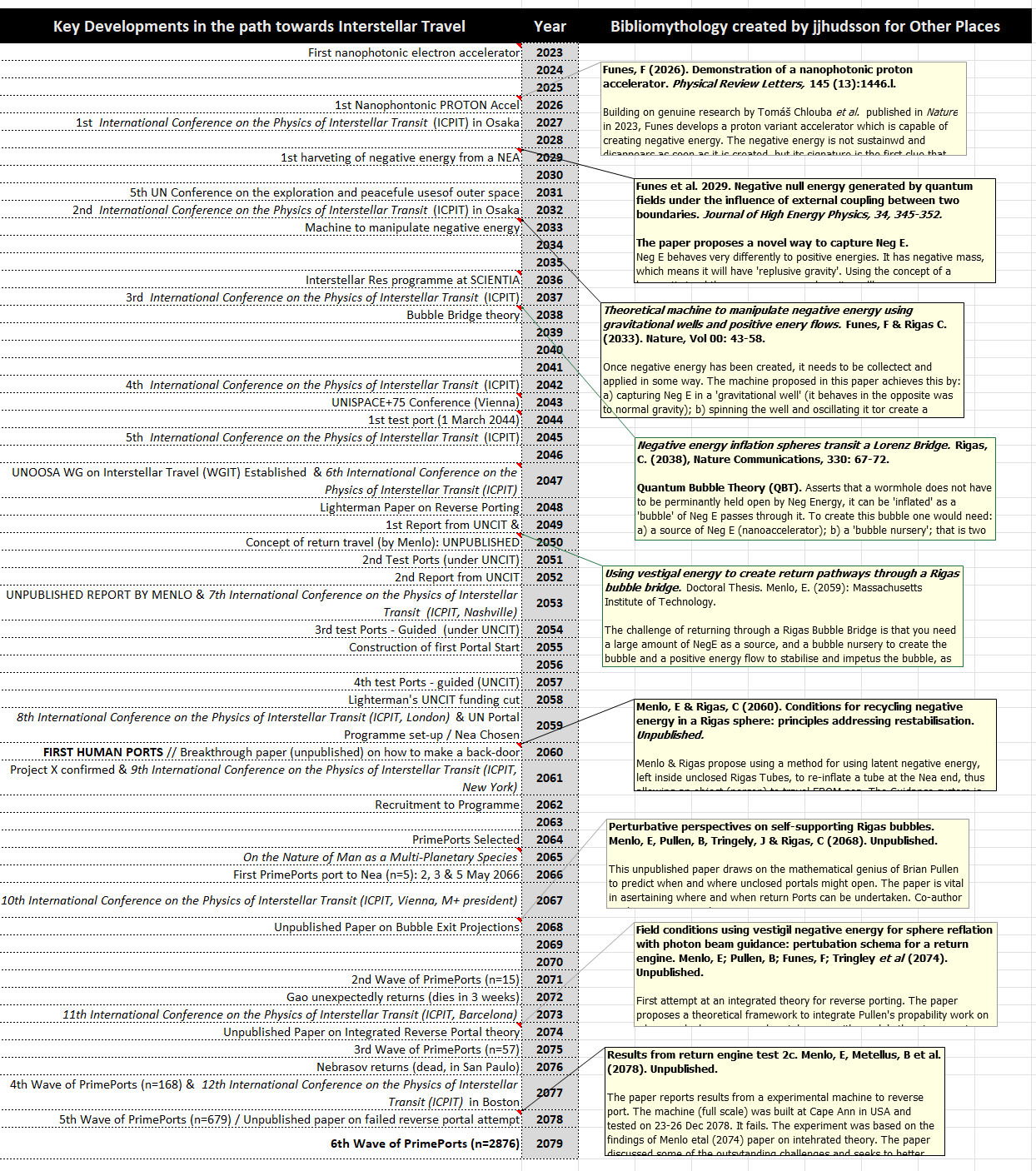
Timeline of events and selected bibliomythography featured in the novel Other Places Which Also Are the World’s End . (Image: The Tricky Genre Press 2026).
Once again we are confronted with the Storyteller’s obsessive search for authenticity in his writing, and the subtlety with which he deploys it his stories. Of these research papers only two are cited in Other Places ; and of the development of interstellar travel, which they chart in no small amount of detail, only a cursory account is given. This is all, no doubt, to the relief of those not inured to hard sci-fi. But, of course, it is a hint that there is more to this story than science fiction. The quest to go boldly where no woman has gone before, although part of it, is in fact, the lesser part. (Ed. for an account of the contortions subsequent upon this realisation see our blog Trick of the Tale.).
Keen-eyed readers will have noticed that the header of Column Three in the table above contains this strange new word ‘Bibliomythology’. We coin it here in resolution of our editorial dilemma: how to handle genuine-looking but entirely made-up references. We cannot put them in a bibliography proper, for fear some readers may be misled into thinking they are learning about genuine research. Hence:
Bibliomythology (n.): The study of fictional works whose conceptual existence informs a text. See Bibliomythography, a list of such works; bibliomyth, an example of such a work. Like Pseudobiblia, but nicer.
It has to be said that there was some debate about the final choice of the word.
Mercifully (or sadly, depending on your perspective) Apocryphologia went into the bin.
Then Nigel surprised everyone by mashing a small but subtle ancient Greek word to our stem to give Anbibliography, meaning something like the ‘Un-Bibliography’ or ‘Not-the-Bibliograply’. We liked the myrrhic whiff of uncertainty about this term, but Angus objected to it on grounds that people might think it ‘an’ typo (Ed. a bit rich coming from him!).
No one liked Peiter’s suggestion of Pseudobibliography which, although perhaps the most accurate (and possibly even a real word), leaves a bad taste in the mouth, as does the slightly shorter Pseudobiblia, which sounds like the name of a song by a prog-rock group.
We then spent a long time trying to work the name of that great source of The Unwritten - Jorge Luis Borges - into a word. But after you arrive at Borgraphy you begin to question the meaning of life.
Shadow-, Latent-, and Silent- literature all felt like they belong in a university Eng. Lit. Module, rather than in our vivid world of vapours, spheres and spells. So bibliomythology it will have to be - for The Tricky Genre Press at least.
Now that we have our new word, let us give it its archetype - it’s type-work: the paragon of its nascent meaning.
No doubt our readers will have their own suggestions. For our part, The Tricky Genre Press is, for once, unanimous. We voted for the Necronomicon, H.P. Lovecraft’s delicious but never-read book of mysteries.
And if, dear reader, your heart is not warmed by the thought of whole libraries of books that were never written, perhaps Other Places can soften that atrophied organ. In Chapter Two we learn that two-thirds of people involved in everyday human-on-human collisions - such as bumping into a stranger on the street or coming out of a shop - wind up having a romantic relationship with that same person. The author of this serendipitous piece of fieldwork? Gregory St-Jean Guillaume. “To fall,” an-wrote St-Jean Guillaume, “is to be open to all possibilities; it is why it is called falling in love.”
Long live bibliomythology!
Notes
The phrase “to go boldy where no woman has gone before” is a reworking of the famous tagline from the 1960s TV series Star Trek created by Gene Roddenberry (NBC, 1966-69).
The Necronomicon (also referred to as the Book of the Dead) is a fictional grimoire appearing in stories by H. P. Lovecraft (1890-1937).
The blog cover image is Necronomicon prop by Shubi, Public domain, via Wikimedia.