Nea-LY, but not quite
A ramble through the marginalia of Nea
One of the great joys of working on an autograph manuscript (MS) is the prospect of stumbling across the author’s marginalia - the doodles, notes-to-self, sketches, musings and plot ideas that are part and parcel of the writer’s creative process.
Here at The Tricky Genre Press we are blessed in this department because it so happens that jjhudsson is a prolific creator of marginalia. There is scarcely a page of his autograph manuscripts that does not have in the margin (or frequently on the verso) a pencil sketch of a strange creature, a character name, a reference, lines of verse, a spell or two. Whole paragraphs of backstory are to be discovered in the white spaces of his pages, lurking amongst less relevant memos, political manifestos, shopping lists, to-dos and even poetry (in fact, the poems in the collections we e-publish have been harvested from jjhudsson marginalia).
To give you a flavour of this rich source of bibliographic evidence, in this post we look at some of the more coherent marginalia found as we deciphered the MS of our most recent EPUB, Other Places Which Also Are the World’s End.
As readers will know, Other Places opens with a map of Planet Nea (Ed. You can view this map under the ‘Illustrations’ tab). Here we are introduced to the eight so-called ‘supervaporous’ regions of the planet (supervaporous being jjhudsson speak for ‘land sticking out of the clouds’). From a plot point of view, conjuring an entire planet complete with eight topographical regions might be deemed sufficient by most writers. But not jjhudsson. On the verso of the passage in Chapter Five where the feature is first introduced we find this illustration (we’ve asked Jess to tart it up a bit, so it is clearer):
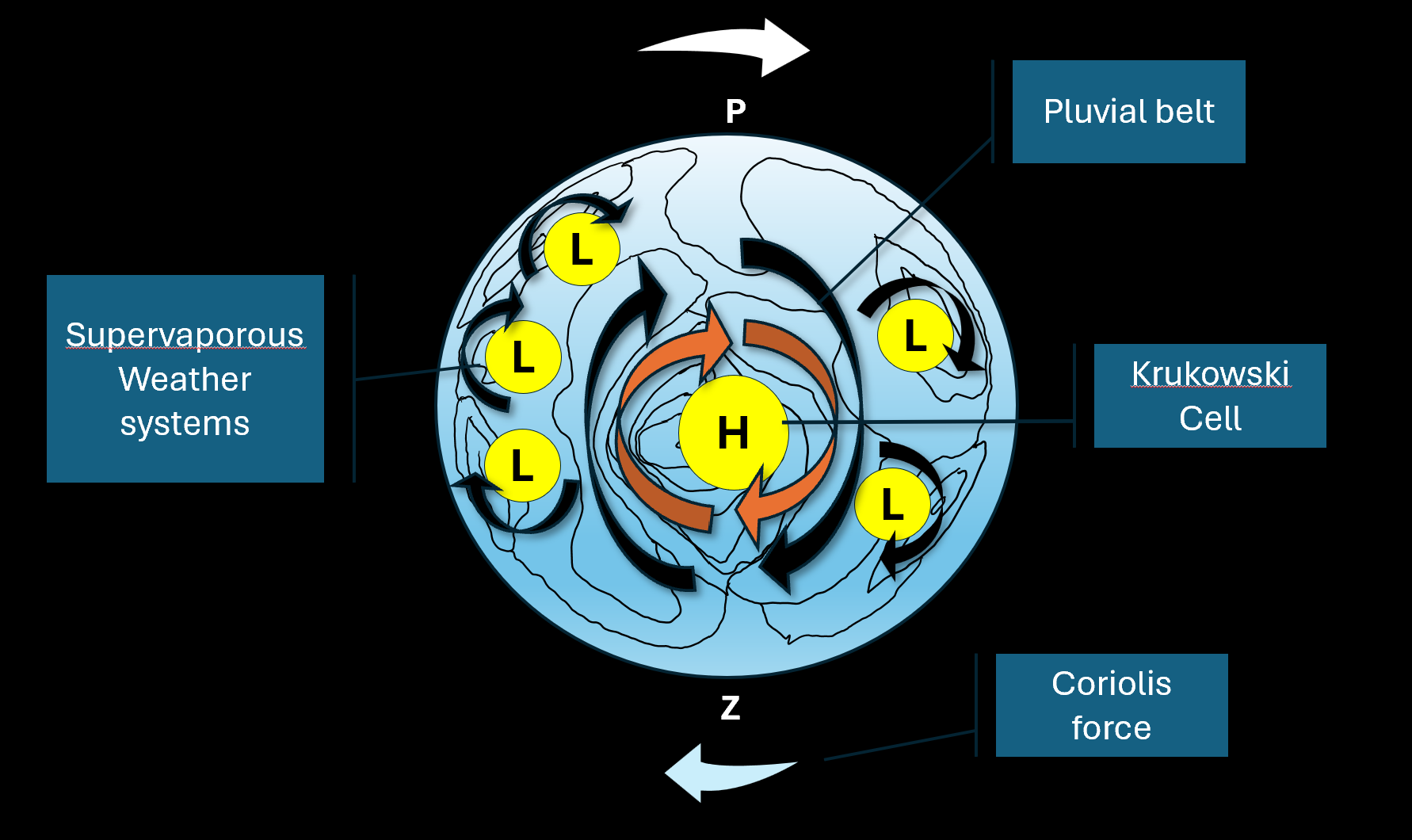
Surface pressure map of Nea, Gydda Constellation, as represented in the novel Other Places Which Also Are the World’s End (Image: The Tricky Genre Press 2026).
We think this is a synoptic chart, or surface pressure diagram, for Nea. The thin black lines appear to be pressure isobars, just like the ones you see on the daily weather report; areas with tightly packed isobars indicate low pressure and vice versa, the whole system being driven by the coriolis force—the atmospheric drag created by the rotation of the planet as it spins through space. Meteorologists use synoptic charts to determine prevailing weather conditions (wind direction, temperature, precipitation and so forth). Is jjhudsson attempting to do something similar here for Nea?
Now before we are inundated with complaints from angry meteorologists, we make no claim the diagram of Nea is factually correct (clue: north is marked as ‘P’ and south as ‘Z’). Indeed, jjhudsson is notorious for failing in his weather predictions, as his dry cleaner will tell you. But it does show the level of detail that the Storyteller puts into his world-building. It leads to passages like the one below from the end of Chapter Eight in Other Places. Here we find Menlo and Deal stalked by something unseen in the fogs of the Cloud Well and having to weigh the risk of losing their pursuer by entering the Pressure Wall:
“The Pressure Wall - or Pluvial Belt, as it is known meteorologically - is a three to ten mile thick band of maelstrom. It marks the boundary between the moist air that has collected at the margins of the Great Central Basin, through which we had been travelling for the last seven and a half light periods, and the clear eye of the Krukowski high pressure cell that sits at the heart of the Cloud Well. The Wall is where the pressure gradient between these two extremes is greatest. It is a malevolent place of violent, unpredictable winds, driving rain and cataclysmic thunderstorms. If there is a place on Nea that resembles hell, the Pressure Wall is it.”
Another example that we came across is even more remarkable. It is a pencil sketch (much spoilt by a wine stain) that sets out the geology of Nea. The autograph is difficult to make out. Here it is, rendered into a colour table by Jess:
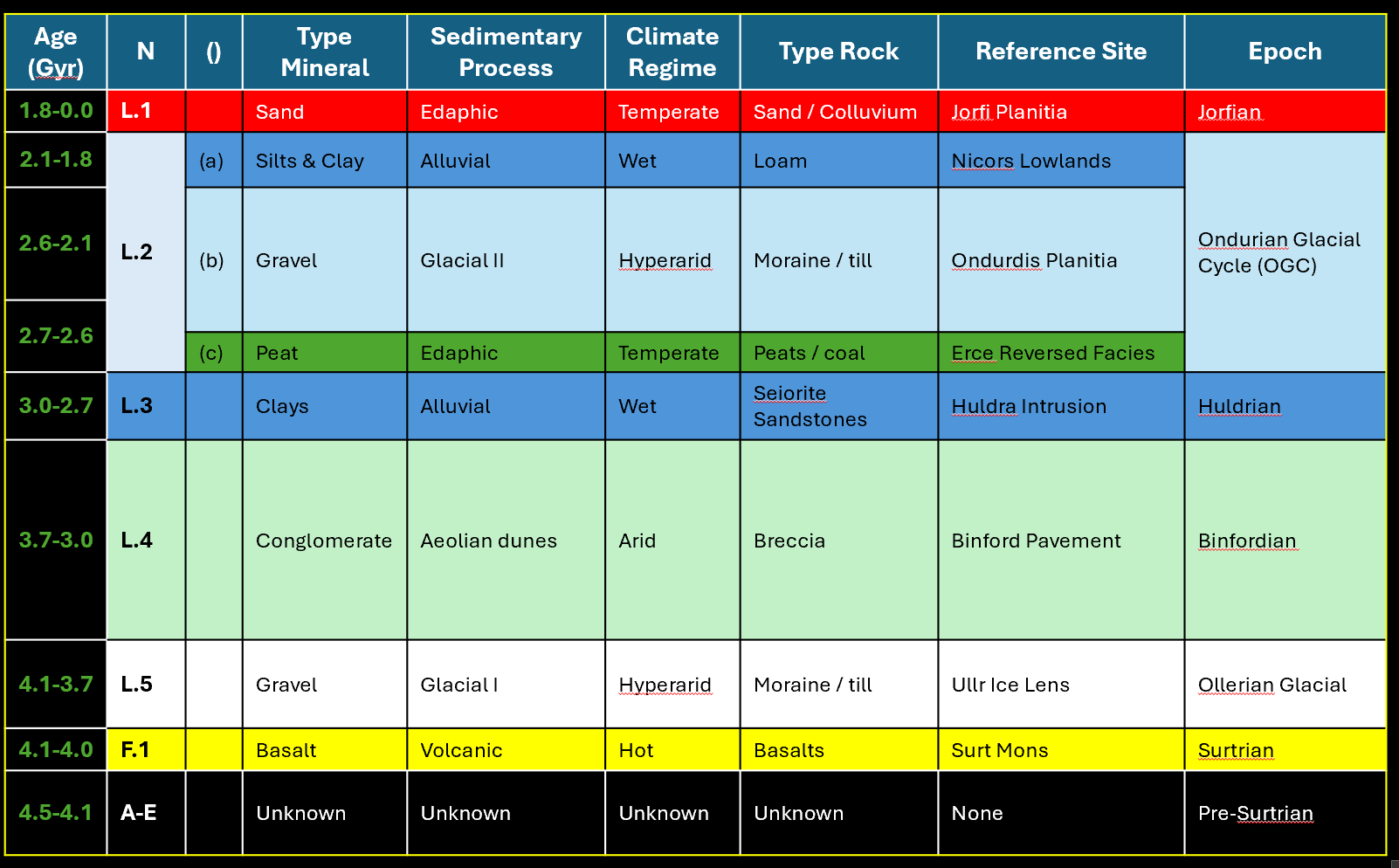
Table of solid geology on Nea, Gydda Constellation, as represented in the novel Other Places Which Also Are the World’s End (Image: The Tricky Genre Press 2026).
What you are looking at is a section through the surface of Nea, from the surface to bedrock (or at least as far as any geologist on Nea managed to penetrate). We are also given the ages of these rock strata (in the left-hand column), from the present to a point some 4.5 billion years ago (roughly the age at which our own planet was forming). The detail here is incredible: two glacial cycles, something called the Binfordian Pavement, a volcanic period and several temperate periods, each one leaving its own distinctive rock-type and soil signature.
But what is remarkable is how sparingly all this background is used in the story. Having gone to the trouble of inventing this geology, an author might be forgiven for deploying it liberally. This is not the case in Other Places. The mysterious Binfordian Pavement is mentioned only once (in Chapter Six); the marvellously named Ollerian, Huldrian, Ondurian and Jorfian epocs not at all; and the volcanic Surtrian is mentioned so tangentially as to be almost off the page:
“He produced a Surtrian cup and, filling it to the brim, waited for me to take a sip…”
Again, we request the Geologist reader to suppress the desire for correction. This is fiction, remember. However, there is one point which even the stratigraphically challenged staff at the Tricky Genre Press noticed: the Ollerian glacial occurs at 4.1-3.7 billion years ago, i.e. at a period when many planets, like our own, were still molten globs of matter floating around the universe. How come on Nea this is a cold phase?
The answer to this question does, in fact, lie in the book - well, a version of the book. The original MS of Other Places is augmented by over three hundred footnotes most of which, as we have observed, are written in the margins of the pages. For reasons of brevity (and because no one at the Press was quite sure which ones were footnotes and which spells), these were removed from the EPUB. However, there is one footnote which appears to settle the question. That’s all we’re going to say. (Ed. The annotated version of Other Places will be available on the Tricky Genre Website on 10 September 2026; in the meantime - and for a modest consideration - the footnote in question is available from Robbie.).
For our final example of jjhudsson marginalia, we return to Earth, or ‘Old Earth’ as it is called in Other Places. If you have read our blog Trick of the Tail you will know that a portion of the story is set on Earth, but it is not an Earth we recognise. We won’t go into the details for fear of spoiling the story for those yet to read it, but amongst the MS we came across the following diagram which clearly pertains to Earth and not Nea:
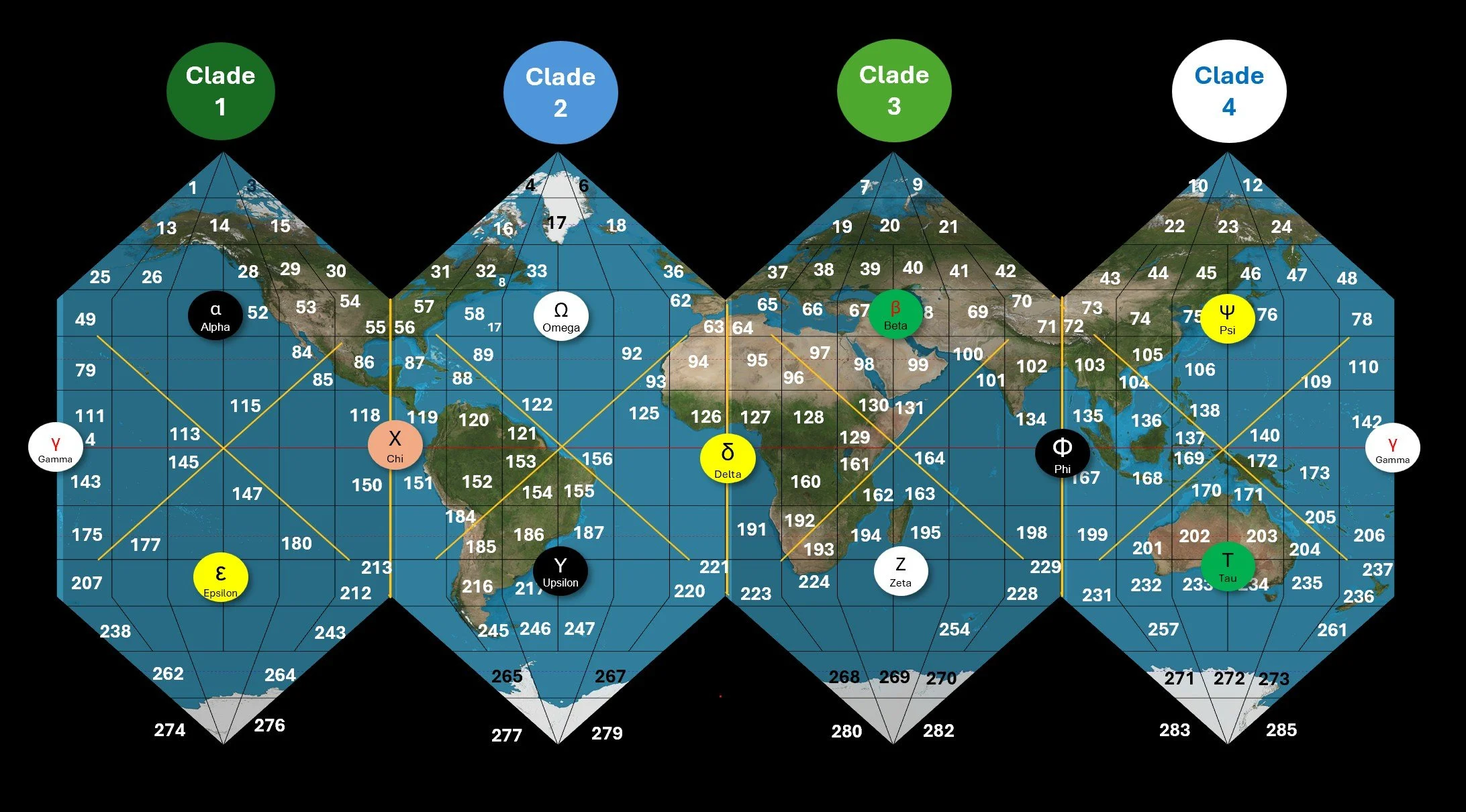
Clade system on Old Earth, post ReAlignment as represented in the novel Other Places Which Also Are the World’s End (Image: The Tricky Genre Press 2026), see Notes for full credits).
It is, we believe, the (or perhaps ‘a’) masterplan of the Clade system. By now the reader will not be surprised the learn that Clades are hardly mentioned in Other Places. Indeed, the term appears in just four places, almost always in passing, as is the case in the following extract from Chapter Two, where the hero briefly muses on the Founding Fathers in connection with her Museum of Lost Worlds:
“…The first thing that intrepid company of adventurers, who numbered only one hundred and two, did when they arrived after having sailed across most of Clade 2, and all of the White Omega Sea, was to wash themselves. No one thought of starting a museum in that Cell for another one hundred and fifty years.”
The reference here to the White Omega Sea links us directly to the diagram, which shows us that it is, of course, another name for the North Atlantic. But why the name change? And what are Cells? You’ll have to read the book to find out.
We end this short excursion through the marginalia of jjhudsson with one last example. The line of glyphs copied below was found next to some editorial guidance provided by Nigel on the original text of Other Places.

Handwritten Inscription found on the autograph MS of Other Places Which Also are the World’s End (Image: T he Tricky Genre Press 2026, see Notes for full credits).
It seems the Storyteller intended to cast a spell upon the Managing Director of The Tricky Genre Press. Angus has traced these symbols to The Invisible Magick Spells of the Afghan Mullah-Sensees. However, he reports a slight misstep: the spell “FOR PROTECTION FROM MAGIC AND EVIL THOUGHTS OF YOUR ENEMIES [cf., we assume, Nigel) appears on the opposite page of the spellbook. The spell written out by jjhudsson is for “PROTECTION DURING MINING AND TO PREVENT MINES CAVING IN.
We note with interest that jjhudsson has not been involved in any mining accidents since.
Notes
The Clade system is based on a map by Strebe - Own work, CC BY-SA 3.0, https://commons.wikimedia.org/wiki/File:HEALPix_projection_SW.svg
The Invisible Magick Spells of the Afghan Mullah-Sensees by Mohammed Ali (1993, Finbarr International).