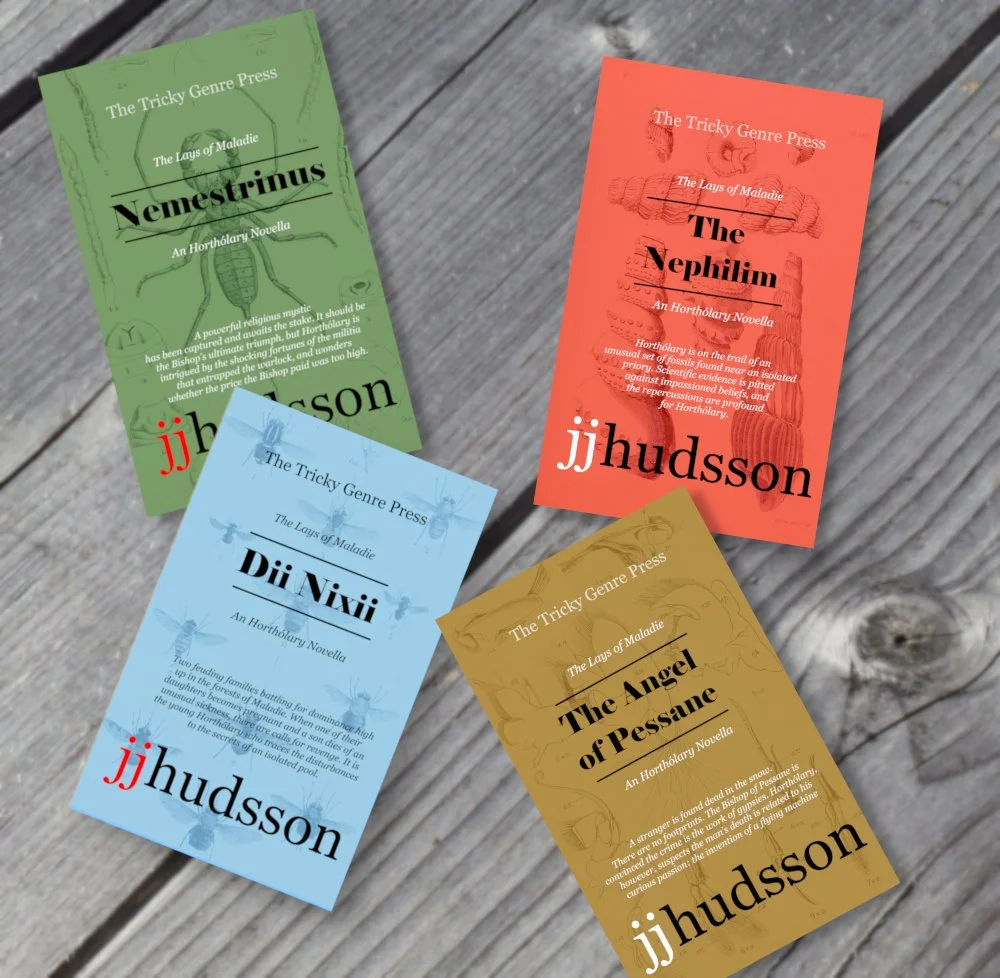
Nemestrinus
A powerful sorcerer awaits the stake. The bishop of pessane is delighted, but Horthólary is intrigued by the shocking fortunes of the militia that captured the warlock. Was the price the bishop paid too high?
Read a sample
-
AUTUMN IN THE Pays Maladie begins high up in the wildwood, far above La-Chapelle-aux-Trois-Vallons, in a part of the forest that has scarcely witnessed Man's cruelty and ignorance. It begins with a single leaf. This leaf, having grown out of the living tree in the exuberant spring-time; having unfolded itself to collect the sun's warming caresses and moved with the tree in the great summer storms; having endured the rupture of clouds (careful always to throw its parcel of moisture onto a root or into a bole) and sung summer’s millennial chant in concert with the forest - having done all these things, the leaf now perceives a new scent on the wind. It is the scent of winter awaking far away in the north and of autumn, her worrisome harbinger, paving the way.
It is as subtle and as powerful as a changing of one's point of view. No more does the leaf feel part of the tree. Like the paddle of a baker sliding between the oven and his loaf, some vital, essential synapse is severed. All at once the leaf has become an appendage, annexed to life like a worn-out old man whiling away the morning in the sun. It loses its shiny lustre, becomes dull and waxy; tiny veins in its skin swell like stiffening arteries and spots of mould and mildew appear on its flesh. There is no doubt about it: the leaf is preparing for death.
And then something amazing happens. As Winter yawns and stretches in her great bed of ice, and autumn's scything winds are unleashed, the leaf transforms into a fiery blaze of russet-red, orange and ochre-gold. And with this one act of defiance a revolution is begun.
Each leaf takes its turn to destroy itself in rebellion at the cruelty of the seasons. The forest catches colour, the sacrificial flames bleeding into the valleys and ravines in great, incontinent daubs of saffron and ruby. Autumn is loose upon the Maladie, and she bounds across the plains.
Burnt up and brittle when the culling winds arrive, the leaf releases itself to the shooshing holokauston [[ Holokauston is the Greek term for a burnt offering.]]- countless leaf-souls shifting spectrally around the forest floor.
The wildwood is full of such ghosts, if one chooses to hear them.
-
HORTHÓLARY PULLS THE sheepskin lap robe over his legs and wishes he were anywhere but in the cabriolet that winds its way through the forested valley between Pessane and Castelagne. This stretch of the wildwood is one of the flattest parts of the Basse-Maladie and yet the highway, which follows the course of the River Durrague between the two towns, is poorly built and scarcely maintained. Horthólary is thrown from one side to the other as the coachman sitting next to him negotiates the potholes and fallen branches that blight the road. He clutches a kerchief to his face. The professor suffers from motion sickness. To mitigate the nausea that is eddying in the pit of his stomach he tries to concentrate on the massive crags of limestone which he can see now and then through the trees. In contrast to the erratic passage of the cabriolet, the heavily forested outcrops march high above the highway in stately procession, their distant ridges hazed over by autumnal vapours. It eases him to gaze upon them. After so many years of exile it is, despite everything, good to be home: good to see the Haut-Maladie in all its glory. If only he would be left in peace to enjoy it.
“How much further?”
“Not far now, sir,” the coachman replies. “It’s around the next bend in the river.”
He has come back to die. So many others he has known have succumbed it can only be a matter of time for him. Perhaps not today, maybe not even this year, but soon, he thinks. His body is tired. His muscles ache from overwork and are bruised from this infernal carriage. But more than this he senses the inevitable running down of life’s pendulum. The slow exhaustion of experience, the leaking away of human cares and contact. There is no cure for this. This is his next bend in the river, his journey’s end.
The cabriolet falters to a halt. They have stopped in the middle of nowhere. Save for the brutal scar of the highway disappearing round a low limestone prominence there is nothing but the river to the south and the forest all around them. A light precipitation hangs in the air. The furnace heat of August has gone out, but the tight-fisted chill of November has yet to blow through. The land is suspended in the pregnant stasis that fills the interstices between seasons. One day, Horthólary muses to himself, the land will say to approaching autumn: Enough! Go back to the North and do not bother us again! And that will be the end of seasons.
There is a grey tethered to a sapling by the track.
“He’s here then,” observes the professor, feeling the mist settle on his whiskers and his cloak.
“Since first light,” says the coachman, clambering down to feed his beast - a chestnut - with some grass. The chestnut is nervous and snorts and scrapes at the ground. “Won’t leave the place ‘til you’ve seen it, sir. Them were ‘is exact words. Get the professor and bring him back here as quick as you dare, says he, I’m not leaving til ‘e sees what mine eyes have seen. And there’s the truth!”
The chestnut raises his head and lets out a whinny. It is not the presence of the grey that unnerves him. There is something unsettling about the damp spot they have stopped at.
“Easy boy,” soothes the coachman, taking hold of the horse’s halter. “Easy there, Minou! He’s got the scent of it already, see?” the man calls over his shoulder as he settles the horse. “They say it’s a wicked thing that’s been done up there, sir.” He nods beyond the grey, where a faint path can be seen leading north-westward, up the lower slopes of forest. “Truly wicked, they say, but I don’t know one way or the other. I ain’t been up there, an’ I ain’t going there neither. You’re on yer own on that, forgiving me, sir.”
The ramshackle cabin lies half a mile above the road, deep enough within the wildwood to be called hidden. Professor Horthólary finds it situated in a small clearing at the end of the track, beneath a modest limestone bluff. It is no more than four log walls and a bark roof covered in moss and lichen. It looks as it has grown out of the forest like a mushroom. Its door faces west, towards Castelagne, and it is standing open as the professor approaches.
Inside the cabin it is dark. Someone has lit a lantern and as the professor enters the light is hastily taken up, as if the holder has been waiting impatiently for this very moment.
“You have come at last,” says a disembodied voice from behind the lantern.
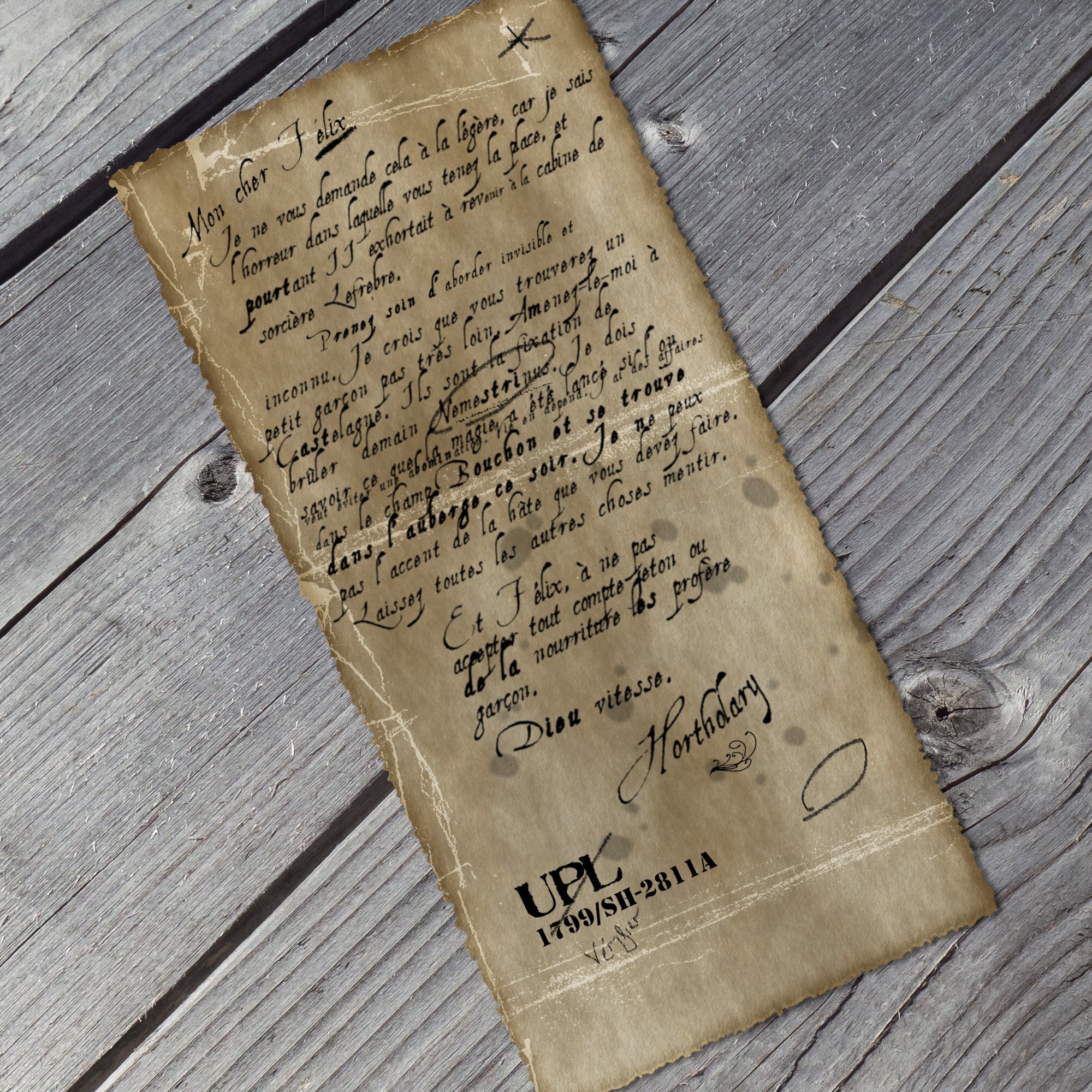
“If Sénéchal Gélis summons me, then I must heed his call.”
“I hoped you would - but I couldn’t be certain.” The voice behind the lantern falters. “I am - I am not my father...”
Professor Horthólary nods gravely. It is two years since Jean Gélis passed over. He misses his old friend and has been shocked at how barren his world has become without him. It is one of the reasons why the old professor is waiting out his time.
“True. You are not your father,” he says simply. “But you are your father’s son, and in you a bit of him lives on. I see it.”
The lantern lowers a little, then descends abruptly. There is a deep sigh from the darkness beyond.
“Alas, Professor Horthólary, I think it cannot be so.”
For the first time a youthful quality gilds the words. A figure steps out into the light of the doorway. It is that of a young man, perhaps twenty-five years of age. He has his father’s powerful build and square jaw, but he wears his dark hair lacquered and long so that the famous Gélis locks are kept firmly at bay. Not like his father in this respect.
“If I were my father - and not a gangling foal pretending to his office - I would know what to make of this...”
The young man turns slightly and raises the lantern once more so that its glow fills the darkest recess of the hut.
Summanus Horthólary has been a professor of anatomy for over fifty years. He has assisted the Sénéchal of Pessane on several of the most unusual cases that the Office has had to deal with. But never has he been confronted with such a ghastly sight as this. The cabin is lined with uneven shelves that have been roughly made using split stems of pine supported by pegs driven in between the logs that form the cabin’s walls. Each is weighed down by an untidy assortment of containers, jugs, bottles, flasks, cucurbits and ewers of every shape, size and function. The professor does not need to open them to know they are the materials of the Apothecary - and of the Magician: cinnabar; juice of pimpernel; Roman vitriol; Gum Arabic; gall nuts; rock alum; green copperas; ash. And of herbs: sage, mint, valerian root, basil, vervain, periwinkle. There are goose feathers everywhere. The fire has long gone out but around the hearth lie scattered other implements of sorcery: a heavy iron pot, wooden switches of various lengths - some with metal caps fitted to their ends - innumerable wooden spoons, burins, bollines[[ Bolline: a white-handled ritual knife used in Wicca primarily for cutting herbs and inscribing candles (Wikepiedia 2026).]] and candles, more clay ewers (of greater size than those on the shelves), a thurible and - in the corner – a dozen lamb skins stretched out to dry on racks. Scrolls of vellum lie on the earthen floor, rolling gently in the draughts that find their way through the gaps in the walls, despite the moss that has been stuffed into the crevices. The only item of furniture is a low wooden pallet set against the eastern wall. Upon this - upright with her back propped against the wall - is a woman. She is neither young nor old. Her thick black hair, shot through with vivid streaks of silver, lies dishevelled about a thin and life-hardened face in which the remnants of beauty have not been altogether erased. It is a visage instantly recognisable to Horthólary, as it is to most men of the Pays Maladie (and more of their women-folk than will ever admit to it): it is the face of Clotilde Lefrebre, the witch.
“She is dead, of course,” offers the young man.
The remark is unnecessary; as soon as it is spoken Gélis bites his lip, regretting the foolishness of it. Horthólary says nothing. His wolf-grey eyes dart over the corpse, devouring every minute detail like bluebottles feasting upon carrion. At his side the young man wants to say more, to spout what little he knows into the dank death-silence of the cabin, but he manages to master the urge. At length the professor concludes his examination and asks:
“Who touched the body?”
“No one,” replies the other decisively.
If you had looked closely enough at the professor you might have seen his right eyebrow flinch. The young man sees it.
“Well ... er...”
He nods towards what remains of the lower half of Clotilde Lefrebre and mutters something about modesty.
Modesty. It is not a word most Maladol would presume to utter about Clotilde Lefrebre. She is the daughter of old man Lefrebre, whose people still live up at Les-Chapelle-aux-Trois-Vallons. There are other children, of course, but Clotilde is the one everyone remembers - partly because she was so different, and partly because of what she became.
It is true that few creatures on this earth can have been as ugly as old man Lefrebre and his wife. There wasn’t a properly proportioned bone in either of them. Their muscles bucked and writhed about their rough frames like a badly fitted harness upon a plough mule, and any exposed flesh was erupted, suppurating, weeping or boiled. It was the great misfortune of the Lefrebre offspring to have these traits ruthlessly replicated in their own much younger bodies. They were plain ugly. All, that is, except Clotilde. She was taller, straighter and more handsome than any of her siblings, with thick untameable hair and the high, scalar eyes of a wildcat. One could almost say she was beautiful - were it not for a single blemish. This mark - this flaw of nature - lay not upon her skin but was encased deep within the darkest cisterns of her soul. It gained form through the myriad prisms of passion and emotion that lie between a heart and its hand. But in Clotilde this incubus, which perhaps we all secretly have shackled and blinded within us, had found a passageway to the surface. When it showed itself, the once fair features of Clotilde Lefrebre bled into hatefulness and the intelligent eyes into raging desire: Clotilde Lefrebre transformed before your eyes from maiden to raven as surely as if her arms had turned to wings and her fingers to talons.
The young girl quickly eschewed her own family as superfluous to the majority of her needs and likewise kept a good distance between herself and the other girls of the Haute-Maladie, whose tittering and game-playing she abhorred. This was a lacuna eagerly filled by their lusty brothers and fathers. Men were drawn to Clotilde Lefrebre like the proverbial moth to a flame. They made no attempt to understand her, to learn what it was she needed from them. They only recognised a wild animal that ran outside the normal strictures of society. A possibility. A creature that might be possessed with impunity. It did not take long before the seed from one of them took within her. Clotilde had no understanding of what was happening, but she knew it to be evil and that it must be exorcised. There was no question of finding help in the bourg. She despised the people of Les-Chapelle-aux-Trois-Vallons. Instead, like many before her, she sought out one of the old hermit-women who passed through the forest like wisps selling spells and charms, potions and talismans. She had heard that these women (les dames sages, the Maladol call them) would buy anything from a wart to a canker: a few sous; an incantation or two - whatever it took. She learned of one sorceress living in a cave above Grès and one afternoon crept out of old man Lefrebre’s pallet and found the path that would take her there. She did not know it, but she was leaving for good.
Clotilde stayed with la dame sage for a month or more. She was not scared, nor did she find what the lady instructed her to do repugnant. Indeed, it seemed like something she had known all her life. Diligently, she performed the rituals: she washed herself four times a day; she fasted; at the appointed hour on the appointed days she cut switches of virgin hazel wood and made vellum from the newborn calf. She touched nothing that was profane or out of its time and she recited the appropriate exhortations over all the things she gathered and prepared - driving out any demons that might reside there. Deep in the wildwood, beneath a venerable oak, she described circles in the warm earth with a sword upon which she had engraved the sacred names of the Ones. Within its circumference, in the hour of the planet she had chosen, she spoke their names.
And they came.
On the night she performed the ritual for herself, that same night her bleeding began again and it continued until, on the third night, the demon that had come into her belly was driven out.
Clotilde Lefrebre sat a long while staring at the wizened little creature that had grown within her. Before dawn she had come to two conclusions. The first was that the demon that had possessed her was a wood sprite that must have crept into her mouth whilst she slept; from now on she would sleep wearing a bark muzzle. The second was that she would now devote her life to learning the magic of the wildwood.
“She has done more than devote her life to magic,” mutters Horthólary, looking from the lifeless body to the shelves around the cabin. “She has allowed it to devour her.”
The young man at his side is uneasy. It is true that the wrecked body of Clotilde bears the scars of her lonely years of witchcraft. On more than one occasion the clerics have taken the whip to her and, once, only the intercession of Archbishop Rapin saved her from the flames. But this is not the work of any magic. This is more like the destruction caused by a wild animal. The chest cavity has been torn open. Clotilde’s lungs, kidneys and intestines are scattered over her lap. Her eyes stare blindly into the young man’s as if she is daring him to think the worst. In the Basse-Maladie they are, once again, talking about the loup garou.
A trickle of blood has dried along the side of her mouth. Horthólary leans in to inspect it. As he does so, he says absentmindedly to the young man behind him:
“Do you see what she is clutching in her left hand?”
Young Félix Gélis has already searched the cabin three times for a murder weapon. He is convinced there is none. And besides, what weapon could do this to a woman? What man could do this?
“Blood-stained rags, I believe,” he answers.
“Look again,” orders Horthólary sharply. “And this time open your mind as well as your eyes.”
The professor is irritated, not because the young man has failed to notice an important clue, but because his lapse has reminded him of his loss, the loss of his old friend Jean Gélis. The rebuke strikes hard on the boy, who has called this man ‘uncle’ since he can remember. Félix bites his lip and steals himself to approach the body once more. He clutches a kerchief to his nose and peers at the witch’s clenched fist.
The object she is clutching is about the size of a cooking apple and does indeed, at first sight, resemble a tight bundle of blood-soaked rags. It has no particular shape other than a vague ovular outline and seems to be made of soft matter, for the sorceress’s hand has constricted the middle part of it. About the top and along the sides the object is irregular as if it once formed part of something larger. Now that he looks more closely the young man apprehends, for the first time, tiny tubes running into and out of it.
“Upon my word!” he exclaims in wonderment. “This is some kind of meat!”
He glances at the skins being stretched in the corner of the cabin. “Lamb, is it?”
Horthólary tuts loudly and with his walking cane indicates the mess of putrefying entrails that lie in Clotilde’s lap. The young man is to assume the meat in question belongs to the victim, it is clear, and yet... Félix wishes he had taken greater pains at the professor’s anatomy classes: lungs (the right still in situ), liver, the upper colon...
“The heart,” he mutters to himself. “Her heart is missing...”
“Missing?” asks Horthólary.
The young man stares at him dumbly.
With a nod indicating the witch’s outstretched hand, the professor bids him reconsider his answer.
“But,” he says, stumbling over the words and the gruesome concept, “it is impossible …”
“Is it?” retorts the professor. “I see it most plainly before me. Do you not?”
“It is her own heart, uncle!” the young man implores. “She cannot have taken it out herself, in God’s name, she cannot!”
“And yet that is not the worst of it, my dear Félix,” replies Horthólary, removing a small pair of tongs from a leather pouch which he has unrolled. “Not by a long chalk.”
The professor leans over Clotilde Lefrebre’s white face. Delicately, he places the tongs at the blood-stained lips. The jaw is tight shut, so he prises the mandible down roughly until it gives with a sickening snap and he is able to push the tongs inside her mouth. The young man winces as the tongs rattle against teeth and gums, but after some dexterous work the professor has hold of what he is after. Carefully he withdraws the tongs, which now hold between them a small, ragged morsel of black meat, partly masticated. Horthólary raises the object to what little light is admitted by the cabin door and examines the stuff minutely. He nods and places the material in his kerchief.
“Surely not!” the young man utters. “It is impossible! Inconceivable!”
“Believe it,” says Horthólary quietly. “When the dark forces of Magic are at work we must be prepared to believe anything.”
The light - such as it is, this deep in the wildwood - is beginning to fail. Not for the first time Horthólary senses the grains of his life slipping away. How quickly the nights draw in, he thinks as he pulls his cloak closer around his shoulders. The damp air of the forest clots his lungs like tar. There is another hour’s onward journey before his hands will enjoy the warmth of a fire and his throat a mug of hot wine. He turns to young Gélis, who has followed him out of the cabin. Together they follow the path down the slope toward the high road.
“I fear this business will weigh heavily upon your shoulders, Félix,” Horthólary says. “Rapin is most certainly involved, and the Archbishop is not an easy enemy to have.”
“The Archbishop?”
The young man is surprised to hear the name of the august prelate. “How has he an interest here? And why on earth would that make him my enemy? Surely the Church is our ally if, as you say, magic is here?”
Rapin is now in his seventy-third year but his powers of influence are no less diminished; his war with the professor has only gained in ferocity since Horthólary’s return. Since Rapin took the Archbishop’s robes and moved to Castelagne their paths have crossed no less infrequently nor with less animosity. The professor detected the hand of his old enemy almost immediately upon entering the cabin.
“Did you notice anything unusual about those ewers in the cabin?” he asks his companion.
The young man shrugs.
“I believe they contained water for the most part.”
“It wasn’t ordinary water,” replies the professor. “It was holy water - water that has been blessed by a priest.”
The young man frowns.
“Why on earth would a sorceress have holy water?” he asks. “Surely that would be the last thing she would have wanted near her...”
“Under normal circumstances I would agree with you,” muses Horthólary. “The fraudulent magic peddled by most Dames Sages would not call for it. But real magic - the magic of the Key of Solomon - is as sacred as it is profane. That is what makes it so dangerous. I very much fear, my young friend, that Clotilde Lefrebre has been dabbling in it.”
“You are referring to her heart?”
“There is no other way to account for it.”
They walk on in silence for a few paces, each man deep in the labyrinth of his own conjectures. At length the young Sénéchal asks:
“How do you know that the water is blessed?”
This brings a smile to the old professor’s tired face. For a moment it is as if the fifty years of his friendship with the young man’s father have not ended and they are, again, two boys trying to unravel some childish mystery. The smile flickers and fails to ignite, as has been the case since his return.
“The ewers all had the clay seals chipped off their spouts,” he replies. “Why go to the trouble of doing that unless the seals were important? The ewers themselves are of the highest quality, not the rough things these itinerants man-handle across the Haut-Maladie. Where did she get them? And why destroy the seals? - Ah! Your horse and my cabriolet. We will part here.”
Out of his pocket the professor draws a lamelle [[ Lamelle: a thin slice, chip or blade.]]of clay pottery. “All is evident in the details, Félix. Here - take this...”
He hands the shard to the young man before hauling himself stiffly onto the bench of the cabriolet. The young Sénéchal turns the fragment over in his hands. It is a portion of one of the clay ewers that has come away as the seal was being chipped off. Even in the watery light thrown off the high road, the young man can see the feathers and rampant wolves of the Archbishop’s seal.
“When one is engaged in the business of hiding evidence, it is better not to do it in one’s own home, eh?” chuckles Horthólary from above him. “Now, off you go. It is late and we don’t want to worry that new wife of yours. I shall go on to Castelagne tonight. I have some enquires to make there in the morning.”
He gestures toward the shard of pottery. “Hold on to that. You’ll need it when you make your report to the Archbishop.”
“What report? I have no responsibilities to Castelagne, as you well know, Uncle. My jurisdiction rests with the Sénéchaussée at Pessane ...”
“That’s as maybe,” replies the older man, pulling the lap robe over his knees, “but I’ll wager the summons is at your dinner table this very night. You’ll be wise to attend to it promptly - unless you want the militia at your door.”
With these words Professor Horthólary calls to the driver and the cabriolet sets off down the road to Castelagne.
-
Prologue
The Cabin
Galan's Machines
The Patrol
Witches Thunderstorm
The Inscription
Holy Water
Hands
The Conflagration
Ashes
Epilogue
-
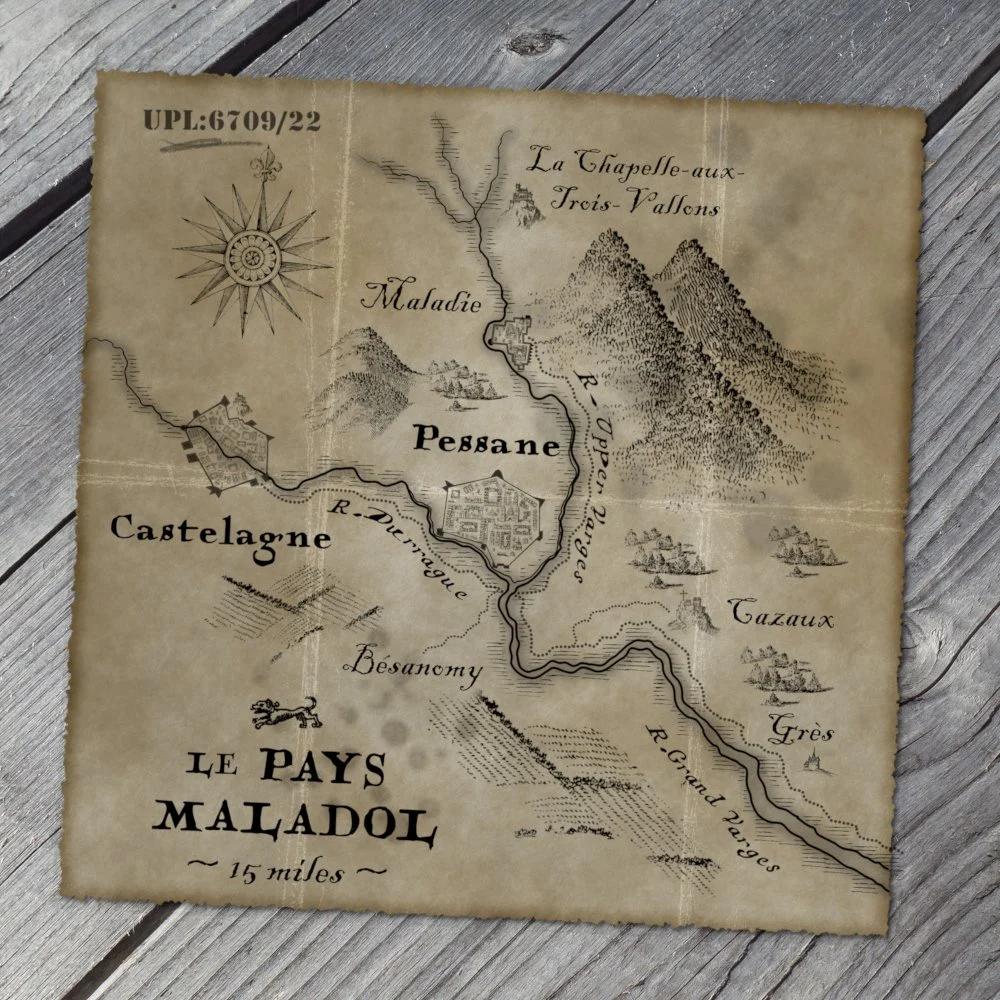
Map 1. Le Pays-Maladie. Map of Maladie region c. 1752, showing the principal locations mentioned in the text (Image: University of Pessane).
Map 2. Vallée de Durrague. The Durrague Valley, Pays Maladie, c. 1769, showing the location of the witch’s cabin relative to the town of Castelagne (Image: University of Pessane).
Professor Horthólary finds himself pitted against his most ardent enemy, the Bishop of Pessane. Nemestrinus, a powerful religious mystic has been captured and awaits the stake in his cell. It should be the Bishop’s ultimate triumph, but Horthólary is intrigued by the shocking fortunes of the militia that entrapped the warlock and wonders whether the price the Bishop paid was too high.