Trick of the tale
The story behind our latest e-pub and how the Tricky Genre Press got its name
The Tricky Genre Press is delighted to announce the e-publication of jjhudsson's thirteenth novel, Other Places Which Also Are the World's End (or, for those of our readers who don’t relish pretentious titles, just Other Places). Incidentally, if you are wondering where the other twelve are, don't: with the possible exception of The Last Theglethon (which we hope to bring you in due course) three are finished only in the mind of the author; the remaining titles form part of jjhudsson’s nine-volume, spoken-word autobiographical disasterpiece Things I Thought but Never Said (need we say more?).
Imagine our surprise, then, when two years ago we found the present manuscript on the doorstep of the Press, carefully wrapped in a Lidl shopping bag, which had more or less completely protected the MS from the elements, baring a few dark stains that looked like curry. Attached to the title page - cryptically marked ‘TBA’ - was a note written in jjhudsson’s hand on the back of a Boots receipt for a family-size tube of Anusol. It ran as follows:
“…you may not want to - but if you do, I shall deny it all. EVERYTHING!!”
Of course, the first thing we wanted to know was: how long has the Storytelller had haemorrhoids? Tulip straightaway put a fiver on six months, based on the unexpected arrival of a standing desk at the Press around that time. It was Robbie - university educated as he is - who suggested we ought to read the MS.
“Yes, we probably should take a look”, said Nigel, demonstrating why it is he who proudly bears the epithet Managing Director of The Tricky Genre Press. Right then and there, he formed a book club. It was ordained that we each read the MS before re-convening in an editorial huddle.
Uncharacteristically the team swept into action. We met twice: once in the Admiral Kirk pub (but only Nigel and Tulip turned up for that one) and again, when Pieter accidentally set the fire alarm off in the kitchen when the battery for his re-chargeable pace-maker overheated. On this second occasion we also benefited from the insight of the staff at the Vigdís Finnbogadóttir take-away restaurant (whose cluster point is adjacent to the Press’s). This - as we shall shortly discover - was a fateful coincidence.
“Well, it’s obviously about an egg”, was Angus’ opener. Angus once claimed to have read War and Peace in an afternoon; he says you only need to read the first and last lines of a chapter to get the gist. Pieter, however, was disappointed. Why? The storyline featured a dog, and Pieter prefers cats. He has dozens of cats which he names after the classical gods; there is even one called Hermaphroditus. (Prophetically, the cat named Hedone died after eating a kilo of marijuana that the local dealer had stashed behind a wastepaper bin - what a way to go).
That left us with the more literary-minded members of The Tricky Genre Press. Tulip - grim-faced - had to be coaxed into revealing that, for her, the book was full of religion and a writer ought to know better than to write about religion. “It’s a dangerous thing,” she cautioned. “Look at that Salmon Rugby and that book of his - what was it called? God With a Small Thingie? Now he has to hide in Luton or New York or some such dreadful place.”
Nigel had just started to say he was minded to think of the novel like a Battenburg cake - the four parts being…When someone [Ed. it was you, Robbie] floored everyone with the suggestion that it might be a philosophical allegory about circular time.
That’s exactly what we all thought. WHAT?
“Well, that’s not going to fit on a cover,” chirped Angus, leaping ahead a few chapters. “Has anyone seen Jess?” (leaping ahead a few more).
“It’s not even a genre, is it?” scoffed Pieter, “I mean, Philosophical Allegory? It sounds more like a bowel disorder than a book. Who’s going to want to read philosophy and allegory - together? It’s a bit overkill, isn't?”
“I don’t think so. I think It’s rather brilliant.”
Who said this? Not Jess (she, as we later discovered, was painting a barn somewhere in the countryside). Who then?
It was Arnora, owner of the Vigdís Finnbogadóttir - The Most Price-friendly Icelandic Takeaway this side of Skálholt, which has the lease underneath the Press. It turned out that the curry stain on the MS was not a curry stain after all - it was herring oil - the very same herring oil that Arnora uses in her famous Ysarullur. “The Story Man?” she now told us, “he’s a regular. I caught him climbing out of the window to avoid you lot; now he slips down the drainpipe whenever he gets hungry. There’s an outstanding bill, you know…”

The Vigdís Finnbogadóttir Icelandic takeway shop. (Image The Tricky Genre Press 2026, see Notes for full credits).
We had a whip around and £6.76 passed into Arnora’s fishy palm together with an I.O.U signed by Nigel for the remaining £745 (mostly incurred on bottles of Engiflugnastada Pinot Noir). But it wasn’t just Hákarl that passed between them - surely she was going to say that next: that during the months - nay, the years - jjhudsson was writing Other Places, the Storyteller confided in this exotic woman; that he revealed to her (and only her) its hidden secrets, its meaning, its intent.
“I wouldn’t go as far as to say that,” Arnora said. “He was drunk most of the time (I’ve never seen a man put back so much Engiflugna with his Þorramatur). “But he did say that it didn’t start out as a philosophical allegory - the novel, I mean. It was meant to be about a woman and a worm-hole. Simple. She goes in and something changes. She’s not the same anymore. A harmless bit of sci-fi.”
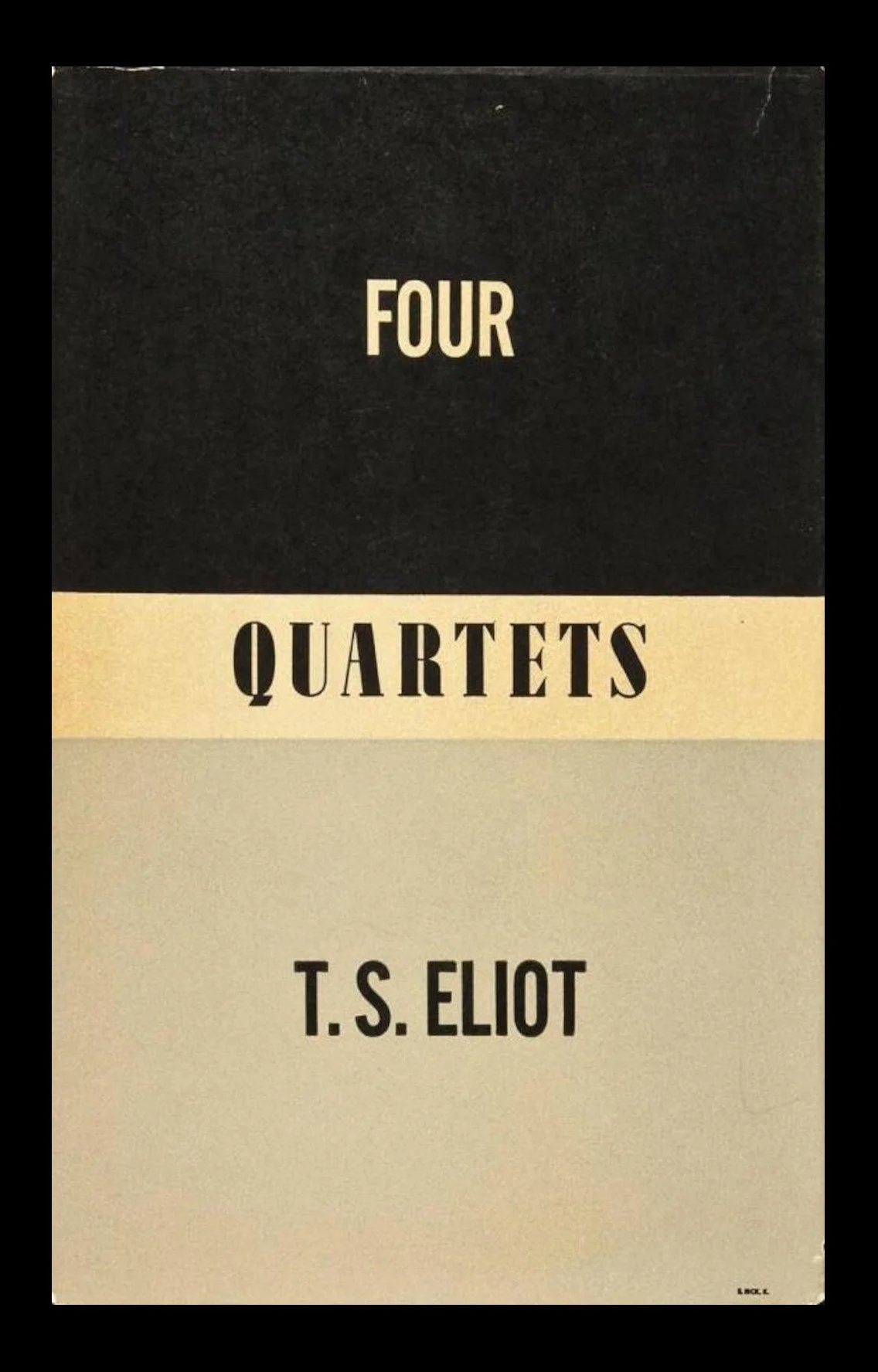
A front cover of 'Four Quartets' by T.S. Eliot. (Image Harcourt / T. S. Eliot, Public domain, via Wikimedia Commons).
The way jjhudsson told it, T.S. Eliot was to blame. Apparently, it is a custom of the Storyteller to read one stanza of poetry on the toilet each morning. This advice, he says, was given him by a Professor of Poetry (although it must be said he was a professor of Spanish poetry, which might explain the verse limit). At any rate while writing the opening of the sci-fi /wormhole drama, the storyteller started to read Four Quartets, Eliot’s late masterpiece, published during the Second World War in 1944. Two things struck him:
the four poems - Burnt Norton, East Coker, The Dry Salvages, and Little Gidding - had a weird capacity to transport him to a very precise place and moment in time; it was almost like, well, time-travel; and
He had absolutely no idea what Eliot was talking about.
These two realisations culminated in jjhudsson reading criticism of Eliot’s poetry. Now, there is a truly vast amount of this, but in keeping with his steadfast work ethic, the Storyteller chose one and read about half of it. The book he chose was Jane Gardner’s The Art of T.S. Eliot (Faber & Faber edition, 1968). This might not be the best criticism of the poet; it may not even be the shortest. But it is the only one to trouble the brow of jjhudsson.
In its pages jjhudsson learned of the method by which Eliot sought to select words that, when placed together, in the crucible of poetic syntax, collided to form new meaning in the mind of the one who reads them. This was the ‘time-travel’ he had experienced so profoundly. More than this, though, was the uncanny (and quite possibly totally irrelevant) connection he made between Eliot’s process and a particle accelerator: both causing collisions to create novelty.
It was a stretch, granted; but then a novelist with only nine-volumes of unpublishable autobiography to his pen-name has to hold on to something. And that something was to use the Four Quartets as a kind of literary wormhole through which to travel and explore - what?
The story had its protagonist, a middle-aged woman named Menlo (Ed. Venlo at first). It had a context (interstellar travel via a wormhole), a theme (sort of - i.e. personal change) and, in the Quartets, it now had its structure; for one of the many things learned from Gardner, was the suggestion that each of the poems in Four Quartets may be loosely associated with one of the four classical elements: air, earth, water, and fire. But what of the substance of the story? What should happen to this woman and why?
The reader will not have to wander far in the literary criticism world of T.S. Eliot to come across the concept of circular time. If they do, they might care to let jjhudsson know about it, for he is still a little vague on the whole thing. Here’s what his Engiflugnastada-soaked brain conjured: think of a spiral, open at the outer edge, but with each revolution towards the centre diminishing until it reaches a point. You might call this point the singularity. Eliot called it ‘the still point’. Now think of a human life as being one of those revolutions. Around and around we go, until eventually we reache the centre - the still point - and, in Eliot’s mind some kind of perfect state.

A circular shape created using light painting. (Image: Subhrajyoti07, CC BY-SA 4.0 <https://creativecommons.org/licenses/by-sa/4.0>, via Wikimedia Commons).
Now, a spiral is not a circle. If it were, our hypothetical lifeline would run endlessly around and around in - well - a circle. Time would repeat itself. We would find ourselves trapped inside the plot of one of those 1990s rom-coms. Suicide would be the only way out. But a spiral is not circular. It’s more like an oval or an egg (a nod here to Angus, whose literary shortcut should never be divulged to A.I.). With each revolution the line occupies a slightly different space and time: its course is similar, but it’s not the same.
Now what would a life look like lived in that way?
One should never let a good structure get in the way of obfuscation. The Four Quartets may be about circular time; it may not. Life might be an iterative movement towards something; it might not. But the potential in this concept for narrative drama, if it could only be framed in a plausible way, was compelling to jjhudsson, if no one else.
A woman travels through a wormhole and finds her whole life altered. She is on a different track, a different circuit of the spiral. In this cycle incredible scientific breakthroughs have been achieved and poorly managed (sound familiar?). In this cycle, terrible events have taken place on Earth. In this cycle, geology and biology run differently. In this cycle, there are monsters. And yet in this world our hero now exists. What is she to do? She does the only thing one can do in such a situation: she lives.
So begins the great journey (or journeys) of Menlo. One woman, different lives (Ed. three without giving too much away). On the surface, it’s a simple story of trying to find a way home. But woven within it are the remembrances and foretellings of other lives and ‘other places’.
We all looked at Nigel, our Leader and - well … just our leader. (Actually, not really a leader, so much as a bellwether: a Direction of Travel; certainly someone who’s in the office more than most of us.). He was rubbing his chin thoughtfully. Here it comes, we all thought, he’s cooking up a baking analogy: over-egged? unleavened? A burnt offering?
“It’s going to be tricky,” Nigel said thoughtfully. “Very tricky.”
Notes
War and Peace, by Leo Tolstoy (first published, Moscow 1869).
We think Tulip is referring to Sir Salman Rushdie and The God of Small Things by Arundhati Roy (Random House, 1997).
Vigdís Finnbogadóttir is an Icelandic politician and theatre director who was the fourth president of Iceland (1980-96). She was the first woman to hold the position and the first in the world to be democratically elected president of a country (Wikipedia).
The image of the Vigdís Finnbogadóttir takeway restaurant is actually the Rainbow Chinese Takeaway, Farsley by David Goodall, CC BY-SA 2.0 https://creativecommons.org/licenses/by-sa/2.0, via Wikimedia Commons. It has been edited by The Tricky Genre Press to reflect the content of this blog.
Ysarullur is an icelandic baked dish of haddock with herring or achovies: https://excitedfood.com/recipes/ysarullur
Arnora. The name belongs to Arnora the Yeller, who features in jjhudsson’s upcoming novel, Lossland.
Hákarl is a fermented shark dish popular in Iceland. Engiflugnastada Pinot Noir is a made-up wine. Engiflugnastada features in the upcomong novel, Lossland.
Þorramatur. A traditional Icelandic dish of mixed foods. As far as we know there is no such wine as a Engiflugnastada Pinot Noir, but if you find some, send us a bottle.