Who is Horthólary?
A potted biography
This is a question we are often asked. We’re working on jjhudsson to add a short preface to the Lays of Maladie collection. In the meantime, here’s a potted biography.
Summanus Florent Horthólary was born on the fifth day of August in the year 1729 in the small village of Maladie, some fifteen miles north of Pessane, in the region of France that was once called the Pays Maladol.
His father was a clockmaker - an unusual occupation in a village made up almost entirely of shepherds and charboniers - and this set him apart at an early age from the other children in the village. His mother, Agnès Bérenger, hailed from the nearby bourg of Grès, from where the village habitually drew fresh blood when a match could not be found within its own walls. Her brother was the priest of Maladie for much of Horthólary's childhood, and this no doubt confirmed the family's elevated position in village society.
His most crucial relationship, however, was not familial but his childhood friendship with the two sons of Dr Gélis, the older boy - Jean - in particular. It was through Jean Gélis that the young Horthólary gained entrance to the world of letters, a domain that would have been denied the sons of most Maladol, even the sons of clockmakers.
While Jean spent much of his year under private tuition in Pessane and Castelagne (Dr Gélis owned at least three homes in the Pays Maladie), Horthólary attended the small school in the village and topped up his education though visits to his uncle, Father Bérenger. Meagre as it was, this education, and long summers spent in the company of Jean Gélis (one of which is depicted in the tale called Dii Nixi), was sufficient to allow Horthólary to gain access to the University of Pessane, in 1746.
Both young men entered the Faculty of Anatomy and Physiology (then part of the l’Académie des Apothicaires et Médecins). However neither completed his course. Gélis quickly realised that the opening of corpses was not for him and opted to study Law, at which he would make a successful career (some of this is alluded to in the tale The Angel of Pessane). Horthólary, meanwhile, remained in the Faculty but swapped the surgeon’s table for the cabinets of the anatomist, and under the excellent tutelage of Dr Eduard Huebar (briefly described in the tale The Nephilim), became one of the foremost Natural Scientists of his time.
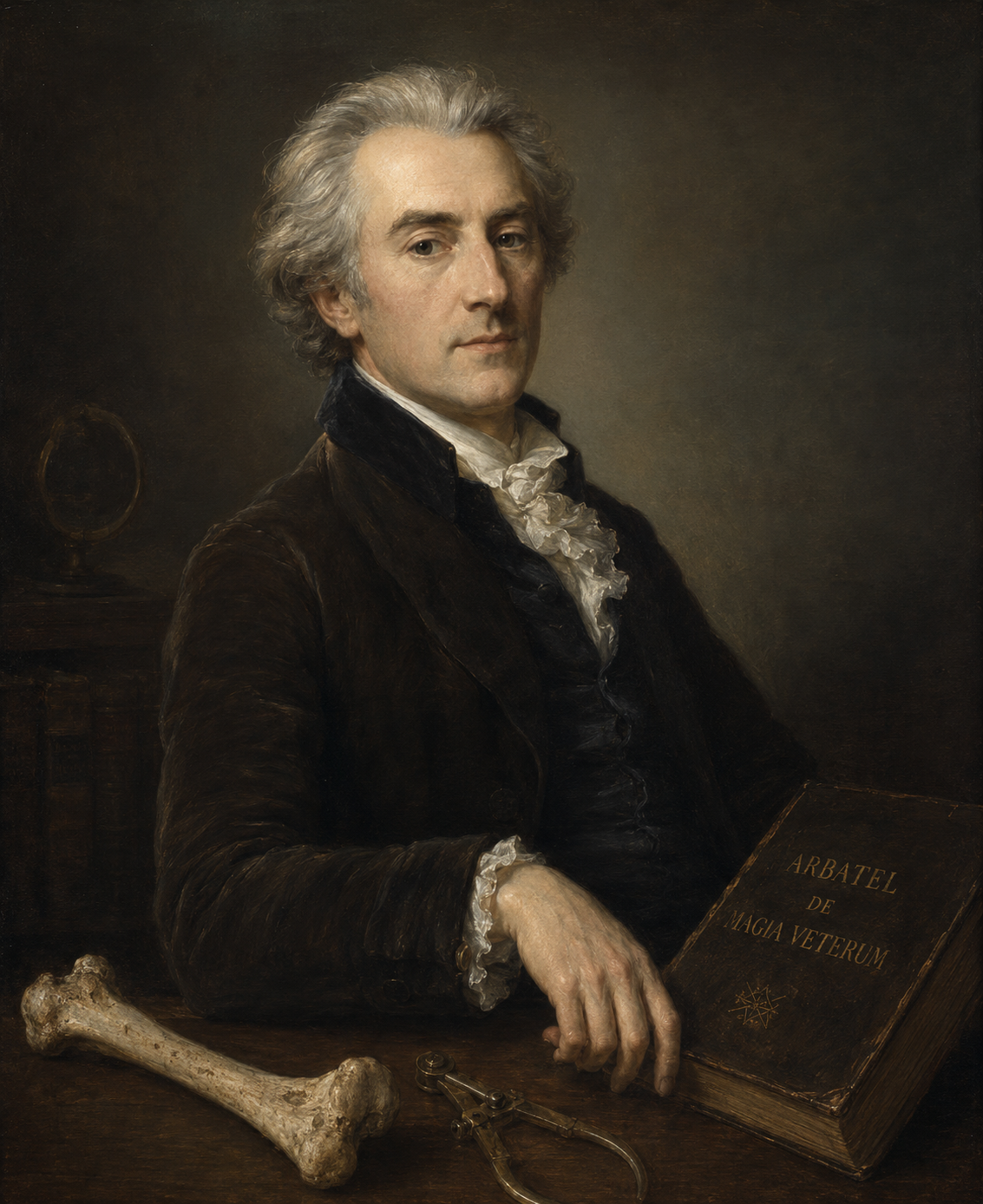
Summanus Florant Horthólary c. 1765, by an unknown artist. Image © The Tricky Genre Press (2026).
After a stint as a lecturer at the University, Horthólary spent three extensive periods abroad. Between 1757 and 1761 he made an academic field trip across Europe, visiting Spain, Portugal, England, Scandinavia and the Prussian states. In 1778 he travelled to North America where, amongst other adventures, he became embroiled in the margins of the American Revolutionary War.
Politics continued to occupy his attention, and in 1792 he was forced to flee his native France during its own Revolution, living in England for over three years from 1794 (the period of the well-known ‘Kingfisher Mutiny’, which tale we hope to bring you in due course).
Horthólary returned to the Pays Maladol in the summer of 1800 to tend to the ailing Jean Gélis (then Sénéchal for the district of Pessane), and although his friend died the following year Horthólary decided to remain in the Pays Maladie - first in Pessane and later, as his health failed, at the monastery at Cazaux.
It is often stated that he lived the remainder of his life in solitude and inaction. We doubt that this was truly the case, and presented here as evidence for this assertion are the dramatic events related in the tale Nemestrinus, which dates from this period of his life. It cannot be denied that the tale is moribund, but it is not quite the last of his adventurous life, as we hope to relate.
Death came for Summanus Horthólary on 24th February 1807. He was seventy-eight years old and, according to his wishes, was buried in the grounds of the Prieuré de Saint-Hugues-de-la-Précipice at Cazaux.
As we relate in an upcoming Tricky Genre Blog, his gravestone can be seen to this day.
Notes
The image Summanus Florant Horthólary c. 1765, by an unknown artist was created using ChatGPT.