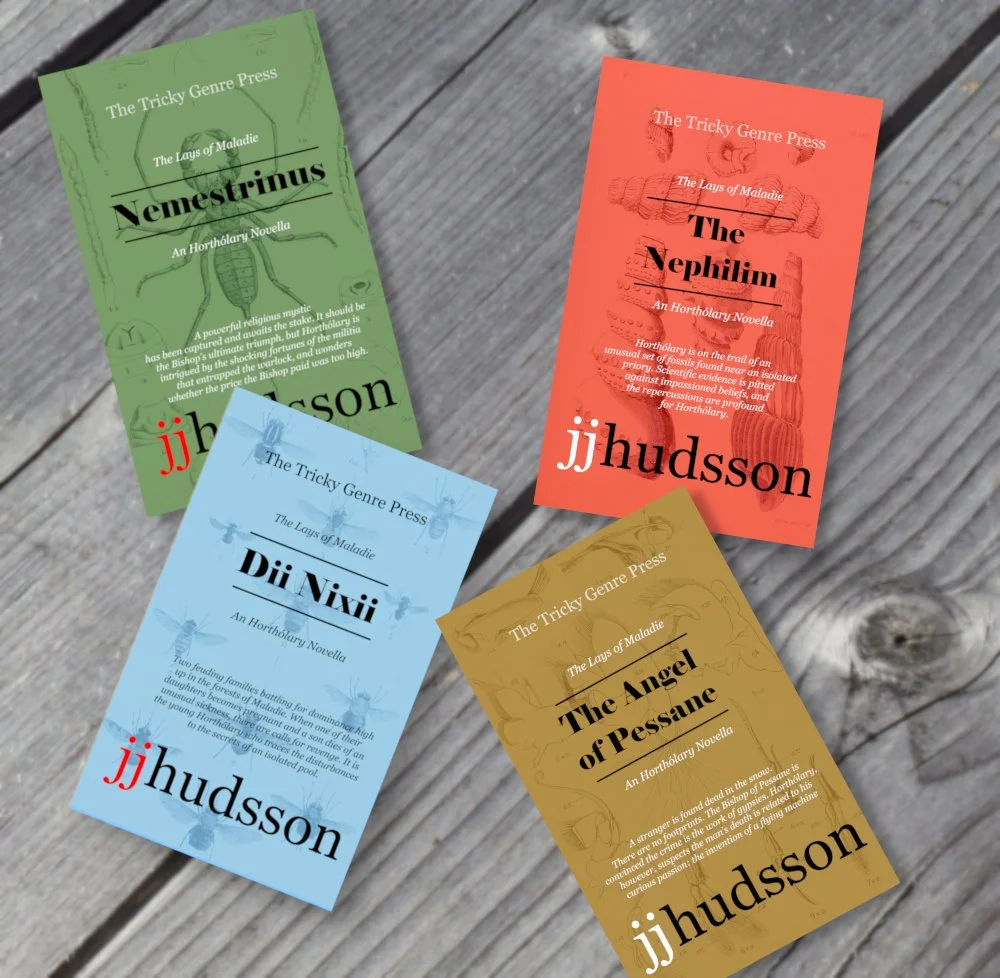
Dii Nixi
Two feuding families in the forests of Maladie. When a daughter becomes pregnant and a son dies, there are calls for revenge. Horthólary suspects the cause of these disturbances lies elsewhere.…
Read a sample
-
MADAME ESCLARMONDE DE SAVIGNY may have been the only person to witness an object reaching across the sky of Pessane in the winter of 1777, but almost fifty years earlier, in the sweltering heat of a July night in 1729, more than a dozen citizens of the Pays Maladie made a similar claim. And this time there can be no dispute in the matter, for the night-time vision was also recorded independently by astronomers in a dozen towns and villages across the country, including Castelagne, Cazaux and Pessane.
The event merits inclusion in these annals on two counts. Firstly, since the phenomenon centred on the small village of Maladie, two leagues to the north of Pessane, we can glimpse in this incident the early development of Horthólary’s scientific mind, for it will be remembered that the professor spent much of his early childhood in that village. Secondly - and this no doubt contentiously - I include the account because it is my belief that the events that unfolded in and around Maladie over the years following the apparition of 1729 are the first recorded incident of extra-terrestrial life on this planet.
-
THE CLOCK-MAKER was accustomed to rise at five o’clock each morning. This meant that his mother-in-law left the warmth of her bed an hour before in order to collect wood from the yard, light the fire and warm his porridge, which he eats before her in silence at the wooden table in the kitchen. She helps him on with a heavy cloak (for notwithstanding that it is the end of July the mornings at this hour are still chilly) and hands him a cloth bundle containing bread, cheese and some wine in a small flagon. With his lunch under his arm, the clock-maker pauses on the threshold and gives the old woman the same enquiring look that he has given her each morning this past two weeks. In return, she shrugs:
“Perhaps,” she is indicating in a gesture typical of the Haut-Maladie. “It will come when it comes.”
The clock-maker smiles a smile of acknowledgement rather than reassurance. Then he nods once, decisively, and walks out into the dawn.
Despite the humble start to his day the clock-maker is, in fact, a wealthy man. If you exclude the absentee landlords and, of course, the Baron of Maladie, who has not set foot in the mountain village for twenty years, there are just two households that pay more to the Intendant. The Poquelin and the Lienard families have earned their money the hard way, through the traditional means of bribery and marriage. And, as a consequence of the unavoidable collision of interests in this regard, each family hates the other with a loathing that surpasses all imagining. The two families live at either extremity of the village in what are, to all intent, separate fiefs; seldom does a Poquelin pass a Lienard but that the two are at loggerheads over some recalled slight or injustice.
Residing in the no-mans’s land that lies between these two families (that is to say, the village square and the church) is the third richest man in Maladie. It is the priest, Father Bérenger. Almost devout, this goodly father has a keen side-business in the sale of sacraments and - more profitably - minor legal work. These transactions provide him with little money but a ready supply of devout women; the one with which to buy wine for his table, the other to warm his pallet at night. Father Bérenger gives a portion of what remains - an amount that he considers to be appropriate - to the Bishop in Pessane, and the rest...well, he shrugs his shoulders in the Maladol way.
Even without access to the records of the Capitation we comprehend the clock-maker is affluent by the standards of the day, because he owns two houses in the village. One is where he, his wife and her mother live. The other is on the Rue des l’Escalier, beyond the Place de l’Horloge, where he maintains his workshop. This is where he is headed now. So let us follow him as he darts down the Rue de Bûcherons and into the Place.
The clock-maker wears linen shirts several sizes too small for him, a custom he has adopted so that the cuffs do not interfere with his delicate work. It is work which, over many years, has given him the craning neck and shoulders of the scavenger-bird. He is scarcely thirty-five years of age. Despite there being nothing grotesque about him, one can hardly say that he is an attractive man. The fault lies - if fault there be - in an abundance of features that draw attention to themselves: lips that are a lick too full, cheeks a touch jowly; a nose that, although proportionate, manages several angles in its short trajectory; triangular wedges of flesh that occupy the ordinarily unremarkable position above the upper eyelid but below the eyebrow. None of these facets attract attention by themselves but the compound effect in the singular visage of the clock-maker gives an impression of the over-ripeness of a fruit which ought to have been eaten yesterday. Something that very nearly approaches ugliness but for which ugliness would be too harsh a word. To these slights the clock-maker is gloriously inured. This is because he sees, thinks, dreams and aspires to only one thing: clocks. Or more precisely, a perfect horological machine. This is his passion and his days are given to the ceaseless contemplation of all the mechanisms and designs pertaining to the science of horology. Experimentation, adaptation, rationalisation, analysis, synthesis, measurement, refinement, repair and consignment are this man’s toil, which he conducts alone in his little workshop in the lower village.
“Guillaume, Robert … Jean,” he mutters under his breath. “No, no. Laurent? Florant? Henri? Fidèle!”
He is turning over names to give the boy (he is certain of its sex) that he and his wife are so anxiously awaiting. He mumbles the names of fathers and grandfathers and the seldom-uttered appellations of uncles and cousins as he crosses the Place de l’Horloge. Indeed, so absorbed is he that at first he hardly hears the dull rumbling that gently parts the virgin air, scarcely senses the quickening wind that builds from across the Basse-country as fast as a carriage and six horses. He does not perceive the tiny point of light dropping out of the still star-laden south-western horizon, nor its tumescence as it veers earthwards. He is looking at the clock upon the wall of the wool merchant’s house which stands on the southern side of the square - his clock. It reads twenty minutes after five.
One cannot easily calculate the odds that an object about the size of a melon, which has been roaming the celestial void for over two millenia should intersect our own small planet at five twenty in the morning of 29th July 1729, or that it should do so over a particular mountain village in the Haut-Maladie. Or that at the precise moment that the object burns through our sultry atmosphere the village clock-maker be standing in the centre of the Place de l’Horloge, the only spot in the village that gives him an uninterrupted view to the south-west, from whence this object hurtles toward the earth. No doubt there have been greater coincidences. And yet it was so that morning – on the feast of Sainte Marthe - that the humble clock-maker became the first human to see what astronomers now call MHU-1729.
“Hullo!” He is heard to exclaim. “What on earth are you?”
The point of light is now somewhat greater than an egg to his eye and still perhaps a half a dozen leagues off, probably over the southern bank of the Durrague. And yet the fretting air jangles and hums like a well-rope and the roaring sound, which had been the first thing to alert him to the impending presence, grows steadily in his ears. He stops and turns to look out over the castellated walls that form the western rampart of the village. From here, the sandstone ridge upon which the village of Maladie is built drops away precipitously. In the colourless dawn, an amorphous blanket of oak forest stretches away before him, like a sea, broken only by the insinuating spires of Pessane in the far-distance. Surely no militia would contemplate approaching the village from that quarter, the clock-maker reasons, even though the western meadows of the upper Varges - still coquettish and unreadable this close to its source - might seem harmless enough at first sight. But the approaching object appears to be no respecter of military strategy. Now - as later - it will prove to be an unconventional adversary, for it approaches diabolically fast from the south-west. Briefly the clock-maker considers whether he ought to raise an alarm. But by the time the idea has formed sensibly in his mind the object is upon the village.
In an instant it passes over the clock-maker’s head with such a clap that a dozen tiles are worked loose from the church and several window plants fall noisily into the square. The sound the object makes as it passes over the village is not unlike the shriek of an incoming cannon shot, only several times louder. Almost immediately shutters fly back from the houses behind the clock-maker and ahead down in the lower village. Naked and perturbed heads peer out, clutching trembling window plants and cursing indiscriminately.
“What in God’s name is that?” cries old Lupercus Lienard. His house is one that faces south onto the Place. “Are we under attack?”
The old man has not been right in his head since an incident, allegedly perpetrated by the Poquelins, saw his brains stoved in with a pole. Now he sees Prussians, Englishmen, gypsies and Pessanole behind every tree.
“Shut up, you old coot!” shouts Madame Poquelin, from the opposite side of the Square. She is in an annexe to the wool merchant’s house; she has the sinecure of Keeper there, but since she has not been paid a penny in years she takes the liberty of sleeping in the empty house when her husband is drunk. “Who would attack at this hour of the night? It’s those wretched cats of yours, knocking over flowerpots and disturbing everyone’s sleep!”
It is true that the Lienard house is infested with all manner of cats but on this occasion the accusation is without merit.
“Cats, you say?” Luperus Lienard cups a gnarled hand to his ear. “It is more likely to be those dogs of yours!”
The debate develops in this vein, with others joining in from their windows. In the middle - alone in the centre of the square, still clutching his lunch under one arm - stands the clock-maker. No one speaks to him or bothers to ask why he is standing there at five in morning, or even thinks to ask him what he has seen. As the petty arguments rage over his head, he is looking up into the sky because across this timeless canvass a new arc has been struck. It begins deep in the west, beyond the Durrague, beyond Castelagne - a black, vaporous scar etched into the western sky like a tailor’s chalk mark. It vaults in an unbroken crescent over the bocage of the Basse-Maladie, over the water meadows below the village and directly above the square and the arguing heads of his fellow citizens. It continues its course north-eastwards into the mysterious and sacred depths of the Haut. It is into this ancient, strange and forbidden terrain that the object, whatever it is, ends its long, long journey.
There is a fizzing sound at his feet. Probably one of old man Lienard’s cats, thinks the clock-maker, absentmindedly turning his eyes from the black streak above him. But there is no cat slinking around his legs. The hissing sound emanates from a small, black lump, that has come to rest on the granite cobblestones of the square. The clock-maker stares at it, and then at the pitchy arc dissipating in the air above the Place. The streak points north-east, in the direction, he thinks, of the Mare de l’Alemone, a small pool deep in the forest.[ The name is taken from the Roman goddess, Alemona, who was associated with unborn children, conception and pregnancy - themes for this tale.] The clock-maker unstops the flagon he is carrying and sniffs the acetic contents thoughtfully. Then, stepping forward, he pours the wine over the hissing object at his feet. The liquid vaporises immediately and the black lump dances over the cobbles emitting a high-pitched whinny. The clock-maker jumps back, clutching the flagon to his chest and guiltily looks to the heads above him. Madame Poquelin has stopped shouting and is staring at him, mouth agape in mid insult. Her unintelligent eyes roam his body searching for the meaning of his sudden presence before her. They light on the flagon of wine. Now there’s a meaning she can understand:
“Drunk at this hour?” she calls down to him. “Has that runt of yours come already, clock-maker? You should have thought about that afore you lay on her. No point in making clocks now - there’s no time left for you! Ha! Go home! Go home and leave us in peace!”
And with that, all discourse upon what has woken the village at this hour is ended. Heads withdraw behind a definitive clatter of slammed shutters and silence - so recently, so violently, ripped apart - closes once more over the square. The clock-maker remains, motionless, rooted to the square. Not much has happened to him in his life and these few moments of novelty interest him greatly. He rasps at the coarse hair upon his cheek and gazes skyward. The trail of vapour arcing above him has already bled into the morning air as if the ethereal artist has lost the certainty of his touch.
“Yes,” he mutters to himself. “It will be today.”
The clock-maker hurries back the way he has come - back to his house. At the door of his mind , several certainties coalesce. He mutters them as he greets each one:
“It will be today. Summanus. Mare de l’Alemone. Thunder. It will be today ...”
In his pocket he carries the lump of black rock from the Place. It is still warm to the touch and smells of burnt wine.
The clock-maker is right that the object that struck across the skies of the Pays Maladie that night landed near the Mare de l’Alemone, a few miles north of the village. He also correct in his assertion that the child his wife is to bear will be a male: the infant boy is named Summanus, after the Roman god of night-time thunder; it seems to the clock-maker the perfect appellation, given the circumstances. However, upon the third head, he misses his mark: Professor Summanus Horthólary was not born for another two days.
-
Prologue
The Arrival
Césaire Poquelin
The Plan of Prisca Lienard
Terrified Fish
The Vallonier
The Pâturage
On the Run
Stultifera Sp.
The Trials of Césaire Poquelin
The Waters Break
Epilogue
-
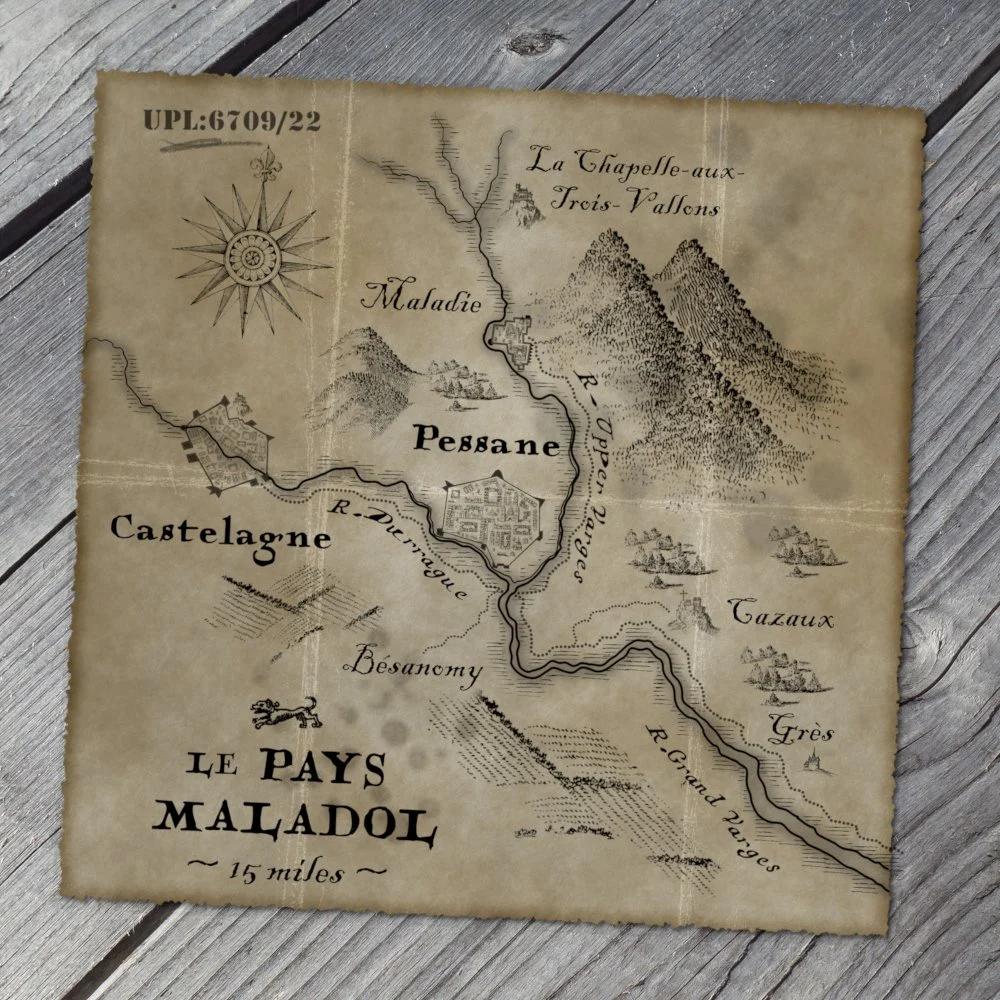
Map 1. Le Pays-Maladie. Map of Maladie region c. 1752, showing the principal locations mentioned in the text (Image: University of Pessane).
Map 2: Maladie-Village. The Village of Maladie, Haut-Maladie c. 1767, showing the layout of the village and locations in the environs mentioned in the story.
Going back in time to when Horthólary was a boy, Dii Nixi relates the story of two feuding families battling for dominance high up in the unpopulated forests of Montagascony. When one of their daughters becomes pregnant and a son dies of an unusual sickness there are calls for revenge. It is the young Horthólary who traces the disturbances to the secrets of an isolated pool.