The Rumour Mill
Professor Tolmie's research records are discovered locked inside a bureau. What was the Grand Experiment he planned and why does the British Government want to keep it hidden?
About the story
-
THE TALE YOU are about to read is one of four uncanny stories that come together in the EPUB collection Foretellings. All four stories were originally published in print in 2011 by Tartarus Press, under a different title. They received modest acclaim at that time, being likened to the work of H. P. Lovecraft by some and Arthur Machen by others. The irony is that the writer had read neither of these august authors at that time and was, in fact, earnestly attempting to ape the style of Algernon Blackwood, who remains—in the eyes of jjhudsson—the supreme architect of the uncanny. For the next dozen years the tales lay gathering static (or whatever is the digital equivalent of dust) in various hard-drives and data storage solutions. It is something of a miracle that they were not overwritten or otherwise lost.
The conception of the tales and, we suspect, something of their final presentation owes much to the means of their first digital birthing. They were written on a Blackberry mobile phone, between the hours of 7.42 and 8.10 A.M. and 6.15 and 6.52 P.M., Monday to Friday. Readers old enough to have survived a working life before Covid will immediately recognise the situation. That irritating person tapping frenetically away on their phone, and no doubt muttering darkly aloud to himself, during both the morning and evening train commute was jjhudsson.
Where the stories came from even he is not certain. We do know that none of the tales was planned: “As far as I can recollect,” the Storyteller has told us, “I just started typing into the Blackberry one morning, and never seemed able to stop.”
We can, however, trace certain experiences, idle conjectures and family mythology that have made it through the mental literary crusher and onto these pages.
For as long as jjhudsson can remember—which is a birthday party at primary school—he had thought it fanciful that the game he knew then as Chinese Whispers (but which we ought now to call by its alternative ‘Telephone’) might be used for nefarious purposes by Grown-Ups. But the opening of The Rumour Mill—in which the idea is played out—came, he tells us, squarely from H.G. Wells’ masterful The Invisible Man. The Storyteller first read this classic while pretending to suffer from ‘flu at boarding school and thereby granting himself a few days’ well-earned peace and quiet in the school’s infirmary. Apart from The Beano the only other readable book in the place was a collection of H. G. Wells’s stories. jjhudsson devoured them all, prompting much concern from the school doctor who could not reconcile the boy’s studious calm with the jagged edges of his fever-chart (engineered, we learn, using toothpaste and hot tea).
Another identifiable piece of literary DNA can be found in Sika Tarn. It is the tale of two companions who set out on a walking trip shortly before the Second World War. Their journey takes them to the far west coast of Scotland, where they arrive at an isolated community perched between the restless North Atlantic Ocean and the brooding height of the local peak, the fictional Ben Callister. Straight away the friends encounter strangenesses, none of which—in and of themselves—is very remarkable, but which gradually accumulate into something more unnerving. Here, the premise of the tale is a shameless mimic of The Willows, by Algernon Blackwood - for our money one of the finest examples of uncanny fiction you can read. Sika Tarn deviates from Blackwood’s eerie tale in circumstances if not in theme. However the events—and the places wherein they take place—are mostly recollected from various family holidays taken in the north of Scotland. Indeed, it might be said that the ending of the tale is the only part of Sika Tarn that is truly from the Storyteller’s imagination.
By now, having tapped out two (to his mind) passable tales, the Storyteller was feeling more confident in his writing. No. 3 Hobbes’ Lane draws on, as far as we know, no pre-existing template. Of course this is a purely subjective assertion; but we are aware of no writer it tries to emulate, no family history it tries to render, no experience it hopes to capture. “It’s a mystery to me where it came from,” confesses jjhudsson. The Swiss-German painter Paul Klee is credited with saying that a line is a dot that went for a walk. “I tend to think of writing in a similar vein,” the Storyteller told us. “A story is a thought that went for a walk”. Evidently jjhudsson has no shortage of weird thoughts, and we know he likes walking. The starting point for No. 3 Hobbes’ Lane is an observation jjhudsson had occasion to make on countless train journeys across England to and from university: he noticed that there was one point along the line that he rarely, if ever, failed to look up at, precisely as it hove into view. No matter how deeply engrossed he was in working or reading, he always broke off and looked up at the exact moment his speeding train passed this particular vista. It was—not to put too fine a point on it—uncanny. The Storyteller quickly formed a theory to explain the phenomenon which we won’t bother the reader with just now, but it is this same sensation that starts Bennellick on his ruminations about the Turnabout House. Of what happens thereafter, all we can say was that it must have been a long and very enjoyable thought-walk for the Storyteller.
Actually, Klee conceived of several types of lines with differing properties. Another, which we like very much, is the line that was in a hurry; it wants to get from point A to point B as quickly as possible. This must surely be the condition of the reader who is anxious to get on with the stories. So let us say of The Visions of Lazaro—last of the four stories herewith—that it is certainly the most complex of the four, blending two apparently disparate narratives. It stands out in other ways too. The Visions is the only one of the four tales to be set in the future and which, indeed, might correctly be termed science fiction, as opposed to the pseudo-historical fiction of the proceeding stories. Re-reading it after twelve years jjhudsson says he was proud of the way in which this fact emerges by degrees. “That story is where I first started to explore structure in my writing.” The plot features ‘ribbons of space-time’ (a no doubt ill-informed concept meant to represent parallel universes) which can thread between one another or become tangled and knotted. The two narratives, which at first seem to be unrelated, are an attempt to capture this effect in a kind of literary origami. Whether it was successful or not, the reader will judge.
There is one other aspect in which The Visions of Lazaro deviates from the three proceeding stories. It is admitted that these earlier stories owe much to a Lovecraftian or Wellsian literary model. In this sense they are descendants of these pre-eminent works. But we were surprised in reading The Visions to find the blueprint for a novel that was not to appear for another twelve years—and which, when it finally was published (in 2026) was authored by none other than jjhudsson himself. The narrative ancestry between The Visions and jjhudsson’s novel, Other Places Which Also Are the World’s End may not be readily noticed by the casual reader, but to the editors of both works are immediate and obvious, even to the point of having to change the name of an important plot element because the name had been used in both stories. We recently read a novella by Thomas Mann called Tristan that seems to contain within it a humorous germ of his later magnificent novel The Magic Mountain. We are not claiming the same literary genius here; merely—and with some relief—that self-plagarism is a thing.
-
Dedication
Map
Epigraph
Chapter One - The Bureau
Chapter Two - Chinaman's Whisper
Chapter Three - Professor Tolmie's Holiday
Chapter Four - A Winged Angel of Ruin
Chapter Five - The Writing School
Chapter Six - The Man from the Ministry
Chapter Seven - Mr Thornycroft
Chapter Eight - Sedenbourg
Chapter Nine - Die Fensterrevolution
Notes
Acknowledgements
Further Information
-
YOU WILL NEVER have heard of Montmorency Tolmie. Or perhaps I should say The Professor of Ideological Drift and Behavioural Transfer, to give him his proper title. I can say this with tolerable confidence because I myself had never heard of him before I moved into his room at the University College[[ I am thinking of UCL here.]]—and I, as they say, am ‘in the trade’.
“A fine mind,” observed the Head of the Department as he showed me to my new accommodation. “Distinctive, I should say. You are honoured indeed!”
We both looked around the dingy room—he in hope, I in something approaching despair. It did not feel like an honour. The room was not much of an improvement on my interim space in a cupboard reserved for the storage of lantern slides on the fourth floor; all of it represented a considerable decline from what I had been accustomed to in Heidelberg. But it had a window and that window overlooked the city and in that city, somewhere, was Charlotte; and that, in the moment of my life, was enough for me.
The room was small and roughly square. Three of the walls were covered from ceiling to floor in dark wooden bookshelves, all of them empty. In the middle of the room stood a leather-topped partners’ desk—quite important looking—and behind this rested a rickety clerk’s chair that squeaked appallingly when one so much as contemplated sitting upon it. The whole was arranged in front of the large, and much valued, window that should have overlooked Hodge Street[[ Re. Goodge Street.]]. I say ‘should have overlooked’ because although the window did indeed open onto that august thoroughfare, entirely half of it was obscured by a heavy mahogany bureau that ill fitted the one remaining wall space. More than anything else about the room—which, beyond what I have mentioned contained only a hat stand by the door and a wastepaper basket by the desk—it was this singular item of furniture that constrained my spirit. I had barely time enough to note its presence and already I felt that it and I were to be enemies.
It was an immense piece of bombastic woodwork. My limited understanding of such things suggested a Calvinist influence in its design; I had seen furniture of the type in southern Germany and in Silesia and I was not overly fond of the style. It was solidly utilitarian and yet the vital spark of creative joy, so important in mitigating functionality, was hopelessly missing. I imagined that this want had been somehow crushed out of the craftsman by the article itself. Across the Schwarzwald there are to be found pediments crying out for fluting, column heads that mourn lost porticoes, feet and latches that long for the steely caress of the draughtsman’s chisel. The present example was ample illustration of this ill-formed critique. Its lower level was formed of four large cupboards fully four feet high, each with an ornate lock. Above these there was a shallow shelf that ran across the entire façade and this formed a platform for an upper tier that comprised, in the centre, two columnar book cases protected by glass doors, again with locks, and on either side of these an escalation of tiny balconet shelves, each with its own turned balustrade. In its functionality there was an undoubted magnificence for those with the taste for it. But who could tolerate such brutal and uncompromising lines? I immediately decided that it would have to go.
“We’ve shifted all of his materials, of course,” the Head of the Department continued. He always referred to an academic’s books and equipment as ‘materials’, as if we were school children at a finger-painting lesson. “Apart from that great thing, of course,” here he nodded towards the mahogany bureau. “Thought you might like to hold on to that. Nice bit of furniture, don’t you think?”
“Very,” I lied, sensing that this might be an opportunity to rid myself of the monstrosity. “But somewhat overlarge for the room, wouldn’t you say?”
I peered around its sharp corner to get a difficult first glimpse of Hodge Street below. The broad street was quiet at this time of day. The Head of Department looked bemused.
“Nonsense,” he replied outright. I could see immediately that there was no hope of a concession. “It’ll come in handy for all those new Proceedings you young fellows go in for these days. You’ll have it full in no time.”
I couldn’t help noticing that the Head of Department seemed to equate a quantity of well-maintained literature with success in the academic endeavour. Clearly we were going to have more differences before too long.
“Oh and by the bye,” he added, moving to the door with purpose, “we couldn’t get that bottom cupboard open.” He nodded towards one of the bureau’s lower tier of cupboards. “Tolmie must have locked it. No key to be found, I’m afraid. The rest of his materials are in the basement. Cribbins [[ The name is based on the actor Bernard Cribbins.]]will take you to them.” Here he grandly swung open the door as if to exit in style, but instead there entered through it a sulky-looking gentleman in a white laboratory coat who had evidently been waiting outside the room. “Ah Cribbins! Just the chap!” said the Head of Department with satisfaction as the man shuffled by. “Our technician,” he announced with a pride usually reserved for expensive items of apparatus the use of which would always remain a mystery to him. The man sloped to the middle of the room without a word and stopped. “Cribbins,” continued the Head of Department. “This gentleman will be taking over Tolmie’s old room here. See to it that all his materials are brought up.” And then, addressing me. “Anything you want just ask Cribbins here. He’s your man.” And with that he left us, whistling loudly to himself as he ambled down the corridor.
The negotiations concerning Cribbins, myself and the arrangement of my new room are too tedious and unprofitable to merit detailing in these pages. Suffice it to say that it shortly became evident that Cribbins was of a sort that never knowingly spilt the cup of human kindness. His mission in life, it seemed, was to succeed in performing as few of the duties allocated to him as would go undetected by his superiors and to be as unhelpful to his fellow man as it was feasible to be without actually being unpleasant. Thus I soon discovered that upon the matter of the large and ill-fitting bureau, there was no question of its removal to the basement along with Tolmie’s other ‘materials’.
“Too big to get darn the stairway, sir”, said Cribbins.
Neither was it possible, apparently, to install it elsewhere in the Department—not even in the Senior Common Room, where there was plenty of space and as much anachronism to make the piece quite unremarkable.
“The gentlemen won’t have it,” said Cribbins. “An’ besides, it’s too heavy to get up them stairs.”
Begrudgingly, I resigned myself to living with the thing for the time being at least. But even here there were grave and serious obstacles to any measure that threatened to see Cribbins called upon to move from his forlorn position in the middle of the room. Perhaps, I opined, we could remove the shelves from one of the party walls and place the bureau there. That way I might at least enjoy the full advantage of my new window.
“Them shelves won’t budge, sir. Not without taking ’alf the wall wiv ’em,” tut-tutted Cribbins with a shake of the head.
In the end, infuriated by the man’s obstinacy and determined to have my window on Hodge Street in toto, I demanded that the wretched thing be moved in front of the sacred bookshelves.
“Wot—an’ block all them loverly shelves and such?” gasped Cribbins, much taken aback. Evidently he subscribed to the Head of Department’s view that an academic life must necessarily be a full life, at least as far as space was concerned. I, however, stood firm:
“That is my intention, Cribbins. Now lend a hand here.” I moved to one end of the bureau. Cribbins remained transfixed to the spot and watched me distrustfully. He tried another approach (which was, in fact, the same approach only differently phrased):
“But where will you keep all your materials? Those are good shelves, they are.”
“I shall manage,” I chirruped. “Now be a good fellow and help me shift this thing.” And I began to heave. Still the man did not move a muscle.
I am not proud that I had recourse to bellowing at the man, but under the circumstances there was little else to be done. In fact I can find nothing redeeming about the entire episode other than that as we shifted the bureau into its new position—or more truly I should say that as I shifted the bureau, for Cribbins’ assistance in the endeavour seemed more spiritual that material—a crisp, crystalline tinkle betrayed the falling to the floorboards of a key. Curiously, this falling of the key had an effect on the laconic Cribbins, who immediately fell to his knees and like a bloodhound foraged about the dusty floorboards behind the bureau until he emerged holding the item aloft and grinning from ear to ear. Alas I did not share in his glee, being the one of us left unexpectedly holding the full weight of the bureau whilst he conducted his impromptu search; I am afraid that I rather snapped at him to leave the blessed thing on the desk and resume his former position at the other end of the bureau. And that is how it came to be that a number of days later, as I sat gloomily looking at old Tolmie’s mahogany bureau, which now occupied a different but no less substantial portion of my small office, I recalled the locked cabinet and thence the key that Cribbins had recovered and made the rather obvious connection between the two.
It was a wet afternoon. The light of day had fled ahead of the black storm clouds leaving the city in a gloomy half-light and even the brightness of the Portland stone façades had been stained a dreary grey by the deluge. People scurried down Hodge Street under their umbrellas only if they had to; carriages splashed through the uneven and muddy cobblestones regardless. It was the perfect afternoon to do some reading. And as luck would have it some new reports had come in from Neuchâtel that very morning.
Reading it would have to be, for no other kind of work could be done. My books, boxes of specimens and the several dozens of volumes of my research notes remained boxed up in my temporary quarters, still unopened from the journey from Heidelberg. Meanwhile the lugubrious Cribbins and I engaged in a frosty stand-off that had him otherwise engaged and me steadfastly refusing to work anywhere other than in my new room. The situation was growing severe. And yet the reports from Neuchâtel lay unread upon my desk. Only the viscous film of rainwater slipping down my newly won windowpane ran over their pages. My thoughts strayed. I had already made two decisions since returning from lunch. I would have to bribe Cribbins if I wanted my things transported to my new room. And—if I had to live with it—then I would make the wretched bureau my own.
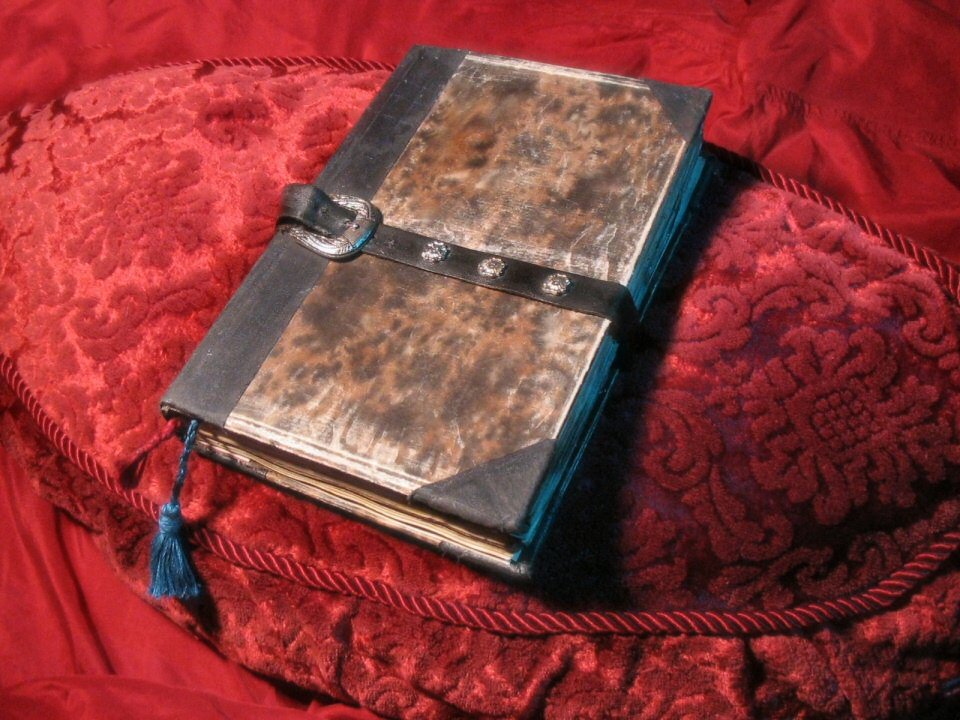
“And I’ll begin by getting rid of whatever is in that locked cabinet,” I said to myself, searching for the key which still lay where Cribbins had placed it on the pedestal of the oil lamp on the desk. It fitted the right-hand cupboard lock sweetly, but turning it I felt the telltale stiffness of some years of disuse. Whatever it was that Tolmie had seen fit to lock up had clearly not troubled him for some time. The door swung open stiffly to reveal a set of three drawers, each labelled in terracotta ink in a tidy, methodical hand. Above these a deep shelf contained some rolled up maps, or such like, secured with faded ribbon and held in place by a small rosewood box. In addition, on a small ledge situated just above the box rested a pair of dividers, a heavy leather-bound book and an envelope filled with slips of paper, each of which turned out to have a familiar phrase or quotation written upon it.
All this interested me not very greatly. Another man’s half-finished studies were as the moon to me. What use had I of them? I had my own work to contemplate. And at any rate who was this Tolmie? Was he important? I had certainly never heard of him. Indeed I think that I should have thrown the entire archive into a box for Cribbins to remove to the basement there and then were it not for two observations. The first concerned the leather-bound book. Upon picking it up I found it to be a copy of Ursprung und Entwickelung der menschlichen Sprache und Vernunft. I knew Geiger’s work from my time at Heidelberg and had no small admiration for the details the philologist had gathered from his native country.[ Lazarus Geiger (1868). Origin and Development of Human Language and Reason (Stuttgart).] That might be worth holding on to, I thought. The second is harder to explain. At first it only dimly reflected upon my consciousness and even now I know not why. It was simply this. Each of the three draws was labelled sequentially: Phase One; Phase Two; and somewhat decisively ‘Final Phase’. There is something tantalising in such ordered progression and although I had not the slightest notion to what, or to whom, these three phases pertained, I was nonetheless much moved to follow them. I cannot account for it. Perhaps it is something in the nature of a student of Man that he must know the beginning, middle and the end of things. Tolmie’s phases certainly promised as much. Or possibly it was the fact that whatever it was that he had been working on had indeed reached its natural conclusion, and therefore the frustration of a fruitless afternoon spent wandering with this stranger’s mind to nothing other than a dead end could be avoided. One never knows, I reasoned to myself, it might prove of value to me in my own work. And at the very least I should be able to say a little about old Tolmie whenever people looked quizzically at his brass nameplate still bolted (immovably, according to Cribbins) to the exterior of my door. “Oh, Tolmie,” I should say. “He did some very interesting work in—.”
I gingerly slid open the first drawer and peered within. There was a great deal of dust. The drawer was filled with a dozen or so black notebooks, each labelled in the same steady hand using the same terracotta ink. They were clearly numbered to indicate the order in which they were written, or in which they were intended to be read.
In the Valais Alps they tell of a wind that comes from the East, over the snow-capped mountains and down through the populous valleys; and when it blows there is always one who answers to it, leaves the warmth of his hearth, takes his skis and disappears into the night.[ This phenomenon is drawn from a short story by Algernon Blackwood called ‘The Glamour of the Snow’ (1912).] They say he is drawn to something on the wind, that he cannot resist its call, that he sees no danger in following it, that he expects everything and nothing. That is how I felt upon looking into that first drawer. I made no conscious decision to pick up the first notebook. I was not aware that I had carried it and two or three others to the desk. I did not even hear the squeaking of the wooden chair as I lowered myself into it. And I certainly did not for a moment imagine that what I was about to read would change the way I thought about the modern world forever.
-
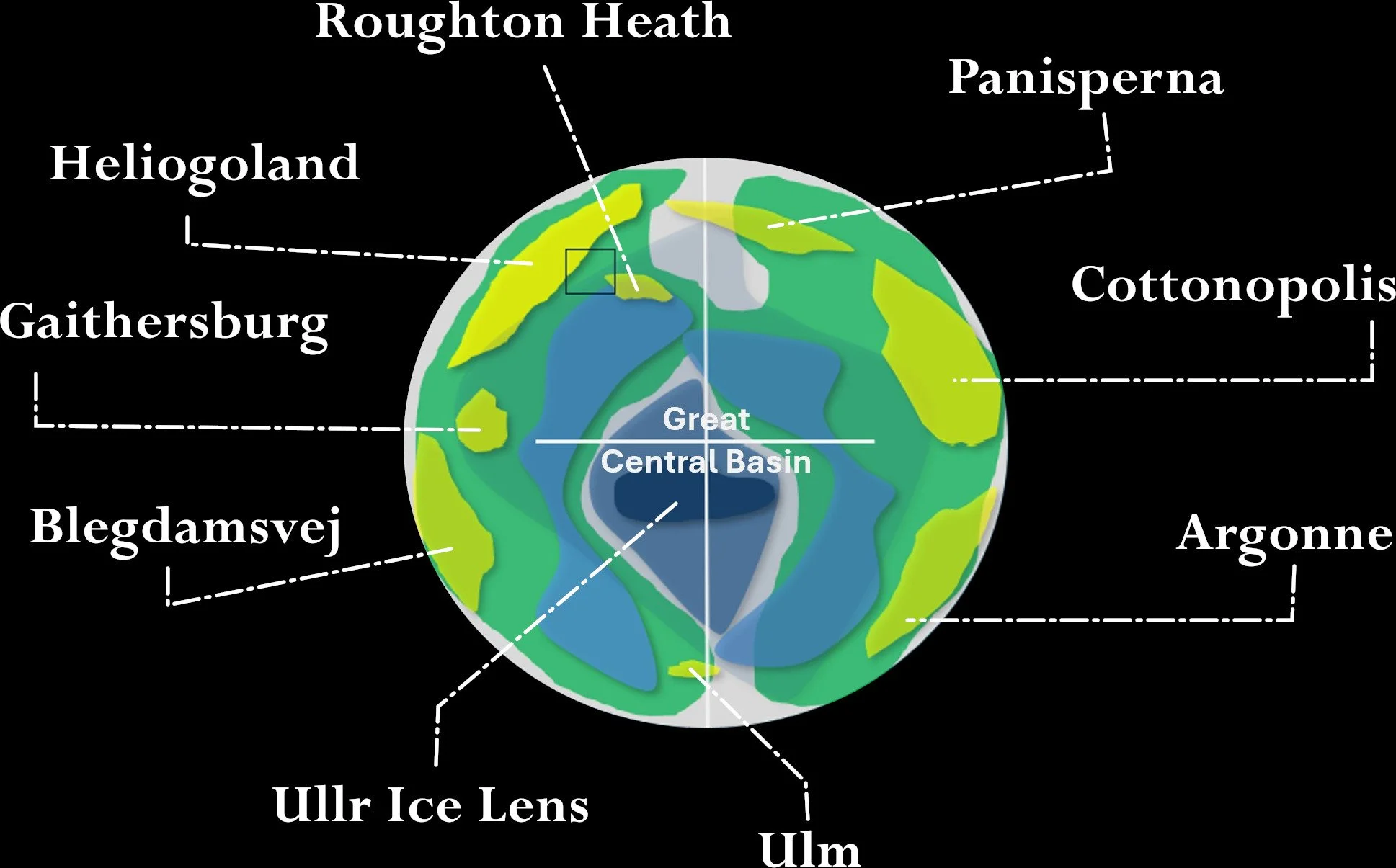
Map. The Imperial Knight Enclave of Sedenbourg (c. 1803), showing the principal locations of action during Die Fensterrevolution of August 1815: 1) Lanz (France); 2) Schloss Riquir; 3) The Pel Marshes; 4) Irion; 5) Mistbrücke; 6) Dornweiler. (Image: The Tricky Genre Press 2026).
Professor Tolmie's research records are discovered locked inside a bureau. What was the Grand Experiment he planned and why does the British Government want to keep it hidden?